Monday, March 21, 2011

Goodbye, Gabaldon, Goodbye!

Not a trace was left of the school where I first heard cicadas sing, where we used to mumble "Land of the Morning," where I learned to write "What I Did Last Vacation," where we learned Good Manners & Right Conduct while lining up for our share of "nonfat dry milk donated by the people of the United States of America," and where I experienced this thing called "puppy love" when I was in Grade 2


The Gabaldon I'm referring to here was the 9-classroom, single story, and cream-colored building that many senior and almost-senior citizens of Dupax del Sur of today certainly have gone to when they were in grade school. Were it still standing today, it could have looked very similar to the picture above of the well-preserved Gabaldon building of Guinayangan, Quezon, that I downloaded from the internet.

The Origin of Gabaldon

Up until recently I thought the word "Gabaldon" was the name for that particular spot of the town bounded by the Laccay and Bato^ lots on the north, the Galam and Latar residences and their adjoining solar on the east, the Benitez guava farm and a child-friendly small hill on the west, and the Abannatan creek on the south.

Through the internet, however, I learned the following:
  • Gabaldon refers to the school buildings built as part of the elementary school training given by the Thomasites, the first batch of American teachers sent to the Philippines aboard the MV Thomas during the American colonial regime; 
  • the blueprint of the Gabaldon Building was a complex containing nine classrooms, a library, a property room, a principal’s office and an assembly hall; and 
  • the buildings were called as such in honor of Assemblyman Isauro Gabaldon of Nueva Ecija who authored Act No. 1801 widely known as the Gabaldon Act that appropriated 1 million pesos between 1907 and 1915 for the construction of schoolhouses of strong materials all over the country.

Gabaldon Memories

Those who went to that one and only Gabaldon building of Dupax del Sur in the '50s up to the '90s would recall that the building then had wide windows made of Capiz shells. I recall the same type of window seemed to be the standard for old houses in Dupax in the 1950s. The roof was also of galvanized-iron sheets, not asbestos like the smaller pre-fab building that we later went to for our intermediate or Grades 5 and 6 classes.

When I was enrolled in Grade 1, the first room that I ever entered in that building was the one on the right. I remember our teacher then was Mrs. Suzon and for the couple of hours or so that I was in her class (before I got "nakalus" or weeded out for being under-aged), I can only remember her pointing to a framed photo of Jose Rizal above the blackboard while telling a story about the guy being shot in Luneta or something. We were too many in that room and the other kids were quite pushy and my little brain then could not quite understand why the fuzz about this Rizal. And so I was listless and preferred listening to the song of the cicadas on the mango tree that framed the right side of the Gabaldon.

Apart from the familiar wide stairway and the long signboard above it that carried the name DUPAX ELEMENTARY SCHOOL, there was a concrete flagpole in front that served as our "save" (meaning, point where one is already immune from being chased) each time we kids played hide-and-seek. When I was bigger, it was a favorite base for teams when we played the then popular game of  "Prisoner." That game as well as that flagpole did much to build our agility and skills not only in running but also in doing the kulkulepot (Isinay word for evading a chaser by running zigzag or from side to side).

I haven't seen kids playing Prisoner lately but, for the record, it consisted of two competing teams fielding runners to chase one another on the then wide open, foot-friendly and thickly grass-carpeted school yard of the Gabaldon. And whoever got touched by a chaser would become hostage or "prisoner" of the chaser's team. The prisoner could however be saved if his team would send one member to sneak up behind the enemy line and rescue him while one or two of his teammates are diverting the attention of the opposition's "soldiers."

I remember there used to be a bell near the door of the front room on the left. Made of a sawed-off World War 2 bomb (almost one-foot in diameter), that bell went "teng-teng-teng-teng" each morning that Mr. Julian Benter (during my time) pulled its string to signal that it was time for us mostly barefooted pupils then to stop running after one another in front of the building, and to fall in line in our respective grades and sections for the raising of the flag and singing of the "Land of the Morning" (yes, we used to sing the English version of the national anthem when I was in Grades 1 and 2), followed -- especially on Mondays -- by a pep talk on good manners and right conduct or other such themes by the Principal (at the time our Domang neighbor Mr. Andres Imperial).

That building certainly helped build the character of today's senior citizens of Dupax. It was where we learned to scrub the wooden floor with coconut husks, to pull stubborn grass such as the po-ot (amorseco; puriket in Ilocano), to sweep the yard of fallen leaves (yes, no plastic wrappers nor other such non-biodegradable litter then), and to fetch water in pails to flush the maggoty toilet bowls behind the building then -- things that many of us certainly did not do in our own houses!

It was also in the Gabaldon where we learned to be good Boy or Girl Scouts and not to push one another each time the "Non-fat Dry Milk Donated by the People of the United States of America" or other such foreign-to-local-taste goods as bulgur wheat, corn meal, cheese, and linseed oil arrived (I don't recall how) and we were asked to fall in line to receive our share. Whenever a classmate happened to have run out of grade school pad paper to form into cone as container for the powdered milk, he/she was always rescued by another who happens to have a thick pad.


Where's the Gabaldon?

I first learned that the Gabaldon building is no more from Mrs. Angelita Ponce-Luma'nga, sister of my Grade school classmate Luis Ponce whose house was near the elementary school, just across the stands of uhaw (a species of bamboo; bulo in Ilocano, boho in Tagalog; ) that formed one bank of the Abannatan brook. This was last January 15 when we went to the funeral of one of Mama's cousins, Uncle Antonio Pudiquet, who carried me on his shoulders when I was around 5 and we went for a picnic at the then still alive and sparkling Salinas Salt Spring (which Ilocanos or people in the area then called galpang).

Uwa Lita of course mentioned the sad news only casually. This was because she was excitedly contributing to the discussion with Mrs. Raza of now rarely used Isinay words among which were the following:
  • arehana (backyard; Ilocano arubayan)
  • galunggung (throat; Ilocano karabukob)
  • ilob-ah (to discard or reject; Ilocano ibelleng)
  • man-alinsaru (to sob; Ilocano agsaiddek)
  • manbinbiniwung (stay uninvolved in the corner; Tagalog magmukmok)
  • manbinbiniyu^ (adolescent woman; Ilocano balasitang; Tagalog dalagita)
  • misepsepat (join a conversation uninvited; Ilocano sumampitaw)
  • mise^se-ung (intrude into a conversation; Ilocano makisawsaw)
  • sumepaw (go over a fence; Ilocano lumaktaw)
  • tiyapong (gone astray; Ilocano bulakbul)
Mrs. Lumanga also animatedly recalled how, when she was in Grade 4, the boys spread wawini (Ilocano sabawil) fruit hair on the girls' desks and the resulting itch she got on her legs, buttocks and pubic area made her go careless in scratching affected parts including their tili-tili (Ilocano sellang; Tagalog singit), in the process raising her skirt like what the other girl victims did. But instead of punishing only the boys, Papa included the girls in receiving whips on the buttocks (or was it being hit with chalk and eraser projectiles?).

Not a Trace Left of Gabaldon

To verify the news, on our way home to Mama's house in Domang after the feast cum reunion that followed Uncle Anton's funeral, I asked my bayaw (brother in law) to let his van pass by the Dupax elementary school. And, indeed, I only saw a couple of goats grazing on the grass that overgrew in the spot where the mighty building once stood. Right then and there, I could only heave a sigh of sadness.

I went back there last March 12, almost two months after seeing the vacancy. What I discovered was not only emptiness but also signs of neglect if not lack of concern for campus maintenance. Naturally, what I saw did not only hit me like something was ripped out of my being; I also felt guilty for my not having been there when they totally obliterated my dear school.

Not only could I no longer associate the unkempt grass and gravel that I saw, with the cream-colored school that used to be my "home" when I was in Grade 2 (under then Miss Jovita Sanchez who held fort in the classroom main door on the right) and in Grade 3 (under then Miss Rosalina Gabriel, main door on the left).

Gone, too, was the flagpole that I never got to raise the Philippine flag on but which served as our "save" each time we played hide and seek when we got sudden breaks from classes each time the Principal (Mr. Andres Imperial) or the District Supervisor (a bald-headed round guy named Mr. Guiab) called our teachers to a meeting.

Indeed, not a trace is left of the school that heard me sing "Lend op di morning, seldi seldi serning... lend deer en holy dudu our sols ador!" All right, this was when it was not yet compulsory for public schools to sing the "Bayang Magiliw" (officially Lupang Hinirang).

Not one bit is also left of the wide building that saw me frequent Mrs. Cayetana Magaway's clinic for cleansing of the stubborn ga-te (scabies; gaddil in Ilocano) on my legs (which I recall I either acquired from too much climbing sapang (kararawit in Ilocano; lubalob in Tagalog; scientific name: Bridelia stipularis) and other such shrubs in Pitang for their fruits that I used as bullet for my kalido^do^ (bamboo toygun; palsuot in Ilocano; sumpak in Tagalog), or from riding carabaos in I-iyo with their hairy hide still wet from soaking in the river).

Not a bit of reminder also remained of my Grade 2 classroom where boys and girls were seated to keep them from making too much noise -- like what our teacher Miss Sanchez had done to me and a sweet-looking girl who I recall was at the time often wearing white sweater and went by the name Mercedes Perez.

Not one memento was also left of the building where in Grade 3 I cherished writing "My Pet Dog" and "What I Did Last Vacation" for my first English compositions under the Ilocana Miss Gabriel.

Not a dust also remains of the rooms that made me enjoy being a teacher's pet as a Grade 2 and as a Grade 3 pupil. (Well, hindsight tells me now I was that lucky not so much because I was doing well in class as because I happened to be the son of Mr. Vicente M. Castro, then a Grade 4 teacher; and that I was a nephew of other sirs and ma'ms like Uncle Ermin Castro, Uncle Cion Coloma, Uncle Polonio Latar, Auntie Tating Fernandez, and Auntie Toring Coloma.)

Not a shard remains of the wooden walls and floors and the GI roofs that were once silent witnesses when, as early as in Grade 2, I had this thing they called puppy love. (Bless her soul, the girl of my dreams then -- I heard the angels took her away one wintry day, only last December, most likely shivering, in a cold foreign land, and probably remembering!)


With the Gabaldon building gone, the school yard of Dupax Central Elementary School doesn't look like a school yard anymore. When I was little, this part of the 8-hectare campus was green with amorseco that we pupils often competed in pulling and which served as our playground for such 1960s games as "Prisoner of War," "innunungan" (wrestling) and "binnansiyan" (where one carried a partner on his back and used him to kick other pairs). At the time, a few meters from the gate (where this photo was shot March 12, 2011), one could already see the imposing figure of the building flanked by the Home Economics Building on the left and a round mango tree on the right that I never saw bear fruit but nevertheless had plenty of singing cicadas.

Call it a case of crying over spilled milk, but I do miss that old school for its having been part of my life when I was growing up. It was where I got to learn and practice my Isinay, where I made many friends among the Ilocano pupils from I-iyo, Manggayang and Bagumbayan, as well as gang-mates from among the Isinay-speaking guys on the central part of Dupax (not yet divided between Norte and Sur at the time).

The building also saw me bond with my father each election time even when I was already at St. Mary's High School and he would be one of the precinct leaders in the inner rooms of the Gabaldon, and I would bring him his lunch that Mama prepared and put in an aluminum lunch box.

There was also one evening Papa took me to watch the burning of old "condemned" books right near the flagpole and as we and the Latar boys watched the smoke billow from the bonfire, I could only feel sorry for those books that could have been given away to be read by my playmates in the barrio while keeping watch of their pregnant ricefields from marauding billit-tuleng (rice sparrows) or while waiting for their carabaos to finish their muddy pond wallow.

Gabaldon Photos, Anyone?

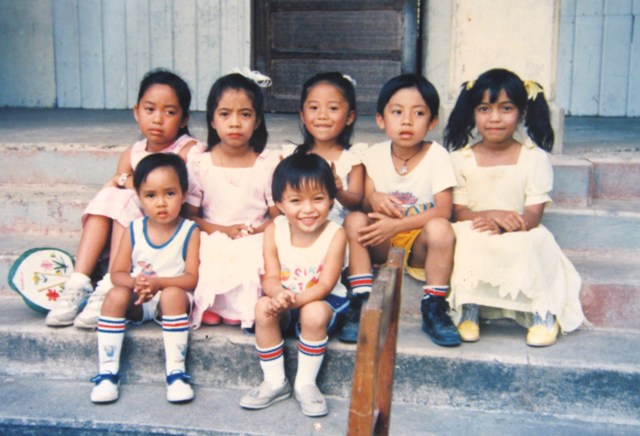
I don't know if somebody in Dupax has kept a "whole-body" picture of the school the way it was when I was small. Which was why when I asked my cousin Ninfa Castro-Tolentino if she happened to have a photo of it in her files and she said yes, I readily gobbled the photo below.

For, even if the picture only shows the concrete stairs of the building and part of a door that I can't even determine if it was one that led to the rooms on the left or the rooms on the right, I'm quite certain that I have walked up and down those stairs and went through that door many times before -- and long, long before the respective births of the bright-eyed kids (three of whom are my "forest products") in this historic photo (taken by Ninfa more than two decades ago).

Taken circa 1988 at the stairs of the now-gone Gabaldon building of Dupax Elementary School -- Front row: Herbert Castro Tolentino and Enock Castro Dial. Second row (left to right): Minerva Fiadchongan Castro, Roselyn Castro Bañez, Leia Fiadchongan Castro, Charles Vincent Fiadchongan Castro, and Audrelyn Castro Bañez.

The Gabaldon was said to have been so termite-infested and earthquake-damaged the school authorities decided a couple of years back it had go. I don't know. But I do have this nagging feeling that those who call the shots for the demolition of school buildings and construction of new ones may have merely shifted more attention to the other school in the middle of the town, near the plaza -- the Governor Alfonso Castañeda Elementary School (GACES).

It's only a building, you might say. But not this building that was on our minds each time we sang this parody of Church in the Wildwood taught to us by Papa's cousin (and my Grade 6 teacher) Estela Guiab Fernandez:
There's a school in the valley by the wildwood
No lovelier place in the vale
No spot is so dear to my childhood
as the little cream school in the vale.

Indeed, the school was almost a girlfriend to me! And so, it is as if the following lines by the British poet and painter David Harkins are beamed in my direction:

You can shed tears that she is gone,
or you can smile because she has lived.
You can close your eyes and pray that she'll come back,
or you can open your eyes and see all she's left.
 Your heart can be empty because you can't see her,
or you can be full of the love you shared.
You can turn your back on tomorrow and live yesterday,
or you can be happy for tomorrow because of yesterday.
You can remember her only that she is gone,
or you can cherish her memory and let live on.
You can cry and close your mind, 
be empty and turn your back.
Or you can do what she'd want:
smile, open your eyes, love, and go on.


Tuesday, March 8, 2011

Farewell to a Great Isinay Teacher

She sang to us the Indian Serenade and Sweet Afton like we were kids that needed pacifying with a lullaby. In her characteristic mellifluous voice she animatedly recited several stanzas of Longfellow's Song of Hiawata. She taught us how to conjugate sentences in English and introduced us to such phrases as apple of one’s eye and emotion recollected in tranquility. And one time that the unmistakable aroma of green tamarind wafted in the classroom, she called our attention to the fact that the correct Isinay word for “sour” was maesom and not mapayit.

A
t the St. Mary’s High School in Dupax, Nueva Vizcaya, easily the teacher who inspired me the most was Mrs. Ermelinda Castañeda Magalad -- or Madam Magalad for short among us her students. Born December 1st, 1910, she passed away in Quezon City last February 19 at the age of 100 years, 2 months, and 18 days, and got interred at the Loyola Memorial Park in Marikina. 

I’m doing a full post about Madam Magalad here not so much because she was the best English teacher I ever had in my 24 years of attending classes (since Kindergarten up to Graduate School) as because it was she who had unwittingly blazed the trail for me to take a second look at the beauty of the written word, including the Isinay language.

A Stickler for Correct Usage

It was Madam Magalad who taught me how to conjugate English sentences. You know the kind -- subject, predicate, object, indirect object, apositive, and all that stuff. (In fact, when  my cousin and St.Mary's classmate Jessie Lopez Castro texted me about our teacher's passing away, that was one of the things that immediately came to my mind. I recalled how one time I was the only one who correctly conjugated a difficult irregular sentence on the blackboard, and my two rivals for the top of the honor rolls looked like they just bit sour tamarind.)

Indeed, aside from introducing us to the concept of idioms, Madam Magalad was also a stickler for correct grammar and correct usage -- be it in English or Isinay. Her pet peeve was "taken cared of" -- it should be "taken care of", she said, as the "care" here is a direct object and not a verb. 

It was from her that I got to learn that the proper Isinay phrase for the English "a while ago" is besan ye and not umommo ya which in itself is wrong grammar. Umommoy, she said, is in the future, meaning "in a little while" or "later."

Today, we lesser mortals would of course refer to umommoy as "by and by."

Inspirational Poem-Songs

I'm not sure now (I too have my "senior moments") but during my time I think it was Madam Magalad who introduced "Laarni a Dream" to us First Year St. Mary's students.  But this I'm sure of: when I was in 4th year, she taught us the tune of "The Indian Serenade":

I arise from dreams of thee 
In the first sweet sleep of night 
When the winds are breathing low 
And the stars are shining bright.

I don't know if it was by design. She also taught us that the very lyrical "Sweet Afton" also had a tune, one that I learned decades later was similar to one of the tunes of the Christmas carol "Away in a Manger."

Anyway, I liked the poem/song's Nature-attuned words:

Flow gently, sweet Afton, among thy green braes
Flow gently, I'll sing thee a song in thy praise
My Mary's asleep by thy murmuring stream
Flow gently, sweet Afton, disturb not her dream

Thou stock dove whose echo resounds thro' the glen

Ye wild whistly blackbirds in yon thorny den
Thou green crested lapwing, thy screaming forbear
I charge you, disturb not my slumbering fair

How lofty, sweet Afton, thy neighboring hills

Far mark'd with the courses of clear winding rills
There daily I wander as noon rises high
My flocks and my Mary's sweet cot in my eye

How pleasant thy banks and green valleys below

Where, wild in the woodlands, the primroses blow
There oft, as mild evening sweeps over the lea
The sweet-scented birch shades my Mary and me

Thy crystal stream, Afton, how lovely it glides

And winds by the cot where my Mary resides
How wanton thy waters her snowy feet lave
As, gathering sweet flowerets, she stems thy clear wave

Flow gently, sweet Afton, among thy green braes

Flow gently, sweet river, the theme of my lays
My Mary's asleep by thy murmuring stream
So flow gently, sweet Afton, disturb not her dreams!


Madam Magalad sang these songs (actually poems by Percy Bysshe Shelley and Robert Burns, respectively) as if we were kids that needed to be pacified or lulled to sleep with a lullaby. But looking back now, I did love not only the way she sang them but also the way the two songs helped me fight bouts of homesickness years later in UP Los Baños.

I loved to sing snippets of the rhythmical lines each time I felt like quitting school and wanting to be just a child again and free to roam the hills and fields and rivers of Dupax. For instance, I would surreptitiously hum them when I did my laundry at the dorm. Or when I crammed for my Trigonometry exams. Or reviewed my bayong-full of leaves and twigs for my tree-identification subject. And when one summer I painted a long-horned carabao amidst the backdrop of a red-orange sunset as a requirement for passing Humanities.

In other words, those songs that I learned from Madam Magalad kept me attached to my Dupax roots. Mind you, it had not been easy. This was because it was fashionable then to belt out songs by the Beatles then the Cascades then Bob Dylan then Peter, Paul & Mary -- then the "Internationale" and "Awit ng Mendiola" and other such activist songs before Marcos declared Martial Law in 1972.

Tamarinds Are Sour, Not Bitter

Ah, memories! One time the unmistakable aroma of green tamarind wafted in the classroom, Madam Magalad didn't castigate whoever it was who brought the fruits to be shared among the girls in class.

Instead, this Isinay teacher of several generations (and daughter of the former Nueva Vizcaya Governor Alfonso Castañeda) went into a little lecture that the correct Isinay term for “sour” is not mapayit but maesom. (Sounds almost the same as the Ilocano naalsem and the Tagalog maasim.)

For the sake of this blog's readers, the Isinay mapayit is of course “bitter” in English (napait in Iloco; mapait in Tagalog). Thus, it is correct to say, in Isinay: “Mapayit di tamtam di apalyar” (The ampalaya tastes bitter). But it is wrong to say: “Mapayit di tamtam sompalo war an mata” (Unripe tamarind tastes bitter).

How I wish Madam Magalad was still in Dupax when I was asking around for the correct Isinay word for "smile."

For, indeed, it took a long time for senior citizens, including Bona^ si Isinay (Isinay Culture) Vice President Abraham Reyes who jokingly proposed mantatawa an marin man-awiwit di tamilnar (literally: laugh but not with twisted lips), to submit their respective guesses before somebody (Uwa Sofia Arroyo) came out with the final word mangumimit.

It took sometime, too, before my wedding godmother Francisca Felix viuda de Mayangat remembered her father use the term burarol when I was almost getting desperate asking around for the Isinay term for "kite." Before then, almost everyone I asked who played kites when they were young just said they grew up knowing that that plaything they call ullaw in Ilocano and saranggola in Tagalog was simply referred to as "kite."

I digress, but the prevalent use in Dupax of the English name for kite is similar to the case of the cricket (yes, the black insect made popular by the cartoon character Jimminy Cricket). My father's cousin Ambrosio Mambear and my former neighbor Guillermo "Base" Abijay Calacala Jr. could not recall an Isinay term for it but they do know that the mole cricket (the brown one) is called e-e in Isinay (ararawan in Ilocano, suhong in Tagalog).

A Church Choir Institution

There is a picture or rather a sound that quite often pops out in my mind each time I go to Dupax and visit the St. Vincent Roman Catholic Church (the most famous place in Dupax del Sur whose baroque Spanish-era architecture got it named as a UNESCO world heritage site).

The picture is that of the combined image and voice of Madam Magalad on Christmas dawn masses animatedly leading --

"Christians arise and loud let us sing
To a sweet baby born as our king
Come to a stable where in a manger
Lies a wee stranger bedded in hay."

I'm not sure now if Madam Magalad also sang during Sunday masses. On regular Wednesday afternoons, however, her sweet voice also filled the air when we St. Mary's students went to church for the novena to the Immaculate Heart of Mary (as part of the requirements in Religion) part of which included the singing of the --

"Immaculate Mary, we come at thy call
And lo at thy altar before thee we fall
Ave, Ave, Ave Maria!"

Had it not been for Madam Magalad's leadership, many of us then would not have loved to sing with feeling the Wednesday novena finale:

"Mother dearest, Mother fairest help of all who call on thee
Virgin purest, brightest, rarest help us help we cry to thee!"

During Holy Week when we sang Tantum Ergo the hymn would not seem to be complete then if it did not include Madam Magalad's voice. She was not only our lead singer but also conductor and metronome as she set the keys that would enable us adolescent boys to sing the high pitches without going "kiyok-kiyok" (like wild cockerels) with our vocal chords.

There are of course other choir singers in Dupax then (like Apu Ane Bastero and Juan Dinu). But somehow Madam Magalad's soprano(?) voice would rise distinctly over the other church cantores as immediately after the officiating priest exclaimed “Gloria in Excelsis Deo!" they rendered the truly glorious and heavenly
  
Gloria… in Excelsis Deo!

If there would be any semblance of competition then, it could only be the brightly twinkling star of Bethlehem "walking" (manlaar) towards the manger... while in the choir loft above the two gigantic columns at the entrance of the church, the Spanish national anthem is being played in deafening pitch by the combined forces of the rivals St. Vincent Orchestra and Eagle Swing Orchestra... and high above them all the unbroken bells in the kampanario (belfry) went tang-tang-tang!

Part of those bygone sounds and images inside the church, of course, were us kids attending the misa de gallo suddenly going awake, particularly the boys who immediately followed to church -- with unwashed faces, uncombed hair, still sleepy eyes and all -- any of the two orchestras as they went around the almost 8-shaped main road that looped around central Dupax playing Joy to the World or Ang Pasko Ay Sumapit in a recently done-away-with tradition in Dupax del Sur we called diana.

We would stay awake and would stay so until the mass is over or at least until the joyful pe-re-re-re... perep-perep-perep-perep... pe-re-re-re... perep-perep-pere! has stopped as the brightly shining bittuwon has reached the altar and Joseph and Mary and their entourage of shepherds complete with goats plus the three kings have reached the manger.

I hasten to add here that the apart from the huge "star" our eyes would be trasfixed on the belen that almost always had as backdrop a panoramic view of Bethlehem painted (on glued sheets of Manila paper or cement bags) by the Isinay artist Andres Bombongan who is now also gone.

Madam Magalad's Advice

In the late 1960s, it was still fashionable then for students to have slum books where one was asked by an owner to put in his/her hobbies, favorite motto, favorite actor and actress, ambition, etc. Some of them had Susan Roces, Amalia Fuentes, or just photos of red roses on the cover.

Not one to pass the opportunity of having mementos from friendly classmates, I bought this less riotous and definitely not of the artista-fanatic kind of booklet for one peso and fifty centavos. This one contained the same template asking autographs from people, including their photos (which in Dupax was next to impossible for students to have then, so the normal answer one would get was "see me in person"). And it had space at the bottom for remarks.

Towards graduation time (I think it was a break from Mrs. Magalad's rehearsing us with our graduation song "This is the long awaited day, this is the day we prayed to come..."), I suddenly thought it would be nice to have her sign my slum book. You know what she wrote in her characteristic long-hand?

"Remember journalism? You can do it!"

That single liner, along with memories of her maesom and besan ye reminders, became one of my guiding lights for a long, long time when I had to engage in some "emotions recollected in tranquility" even long, long after I left the portals of St. Mary's! -- charlz castro

Thursday, March 3, 2011

Thank You, Lord, for Clean and Quiet Places Like My Hometown Dupax

My town mates may grumble about how so-called progress has been turtle-paced, if at all, in Dupax del Sur.  If I had my way, I like the way my birthplace is -- quiet, pastoral, unpolluted, far from the madding crowd.

Dalihan, Barangay Palobotan, Dupax del Sur, Nueva Vizcaya around 6am of Dec. 28, 2010

Indeed, now and then, one could hear somebody complain how far behind our town is compared to its neighbors.

We still don't have factories, bakeries, restaurants, drugstores, banks, souvenir shops, tourist inns, gasoline stations, bus terminals, and videoke bars to lure visitors and investors -- and to keep young Isinays and Ilocanos from seeking the so-called greener pastures in Manila, Hongkong, Japan, the Middle East, Europe, or America.

But who cares about factories, bakeries, restaurants...?

Who says that noisy, filthy, congested towns are better than the blue and sleepy hills, the clean and serene rivers, the sparkling ricefields that are verdant green one day and heavy with golden grains the next day?

Okay, go take a bath in your progress.

Go on and chew your banks and souvenir shops and gas stations and tourist inns.

Go feed your kids with your videoke bars and bus terminals.

Just leave my hometown alone.

Let me live where there are always sunny days and frequent rainbows and myriad stars at night.

Let me wake up mornings on a bed of hay and where smoke billows from a cogon-roofed hut. Let me continue to smell the aroma of boiling corn, roasted peanuts, or mudfish broiling on the dirt stove.

Let me listen to the laughter of children on their way to school a couple or so kilometers away. Let me hear the song of the pond by the road as a carabao swats the swarm of flies by its muddied tail.

Let me watch how the sun goes up, how it awakens the warbler and brings color to the fields as they get speckled moments later with men and women joyfully planting or harvesting rice.

Let me bathe on streams with cows munching dew-bathed grass on their banks. Let me try my luck at catching red dragonflies or stealing a leaf from the touch-me-not plant without causing it to close shop.

At noon, let me be with sparrows as they chase stubborn May beetles and katydids. Let me lay down on a cogon hut by the field and fall asleep with the song of cicadas and a solitary hawk circling high in the sky.

At twilight, let me regain my breath so I could say goodbye to the silhouette of wild ducks flying towards the sunset. After which let me hear the crackle of firewood cooking camote or beans on a black kettle.

Then allow me my ration of a steaming plate of rice and bagoong-dipped button tomatoes and steamed river fern. Allow me too my dose of black coffee half sweetened by homemade molasses.

Then before I say "Thank you, Lord, for another day" allow me to feast my eyes on the twinkling stars or a tree full of fireflies.-- CHARLZ CASTRO

Friday, February 25, 2011

Trees with Ghosts Who Love Women

[5th of a series on folk beliefs associated with trees and forests]

If you get to see certain patches of forest with large trees that appear incongruous or out of place in their generally tree-less or desolate surrounding, chances are that they have been spared from the logger’s axe or saved from being converted into farms due to the belief in unfit or disfavored trees.
Mangoes are certainly magnetic and saliva-inducing fruits be they ripe or green. But did you know that in some communities, single ladies are warned not to go near a big mango tree because it is believed to be the home of a spirit who loves to waylay unescorted women? In Thailand, too, house builders are cautioned not to use the wood from mango trees because it is believed to bring illness and bad luck to the house-owners.


A
s a young forester in the 1970s, I happened to be part of the UP Los Baños College of Forestry team of resource persons sent out to public elementary schools to teach teachers certain concepts about trees and forests. One of the things I loved to share -- and which almost always became eureka moments among the Grades 1 to 3 science teachers I handled in Metro Manila, Nueva Ecija, Mindoro, Lubang, Antique, Iloilo, and Cotabato -- was that of a grotesque tree that usually starts as a tiny dropping of a bird on the branch of another tree. 

The Tree-Killing Tree

That grotesque tree is the balete. 

Indeed, as a plant, the balete starts out as a bird dropping that with the aid of rain and sun soon becomes an epiphyte or a virtual orchid. Available moisture and leaf litter in its perch high up on the host tree would next make the plant turn into a vine that sprouts forth several roots that seem to race though very slowly towards the ground. 

Once anchored on soil, the said roots would next become fast-growing stems whose branches and secondary roots, though not exactly sucking the host tree’s blood, as it were, would soon join one another to wrap themselves tightly around the host tree’s trunk. 

As the years go by, the trunk of the host tree gets strangled slowly but surely by the parasite plant’s fast-growing and intertwining stems. Not only that. Its branches that once served as cradle to the parasite, protecting it from wind and the scorching sun, soon become smothered by huge ingrate branches.
And finally, despite valiant efforts to survive, the poor host tree withers and dies -- and its place under the sun taken over by a multi-stemmed and dreadful-looking tree they call strangler fig or balete.

But that’s not the end of our story. 

The balete would later become a huge and wide-trunked tree especially if no one would dare prune or thin its prop roots or nip the “aerial” ones in the tip. When the tree bears flowers, a lot of insects would be attracted – bees, butterflies, ants. When the fruits start to become crimson then purple, several kinds of birds would come feed of the seemingly endless supply of luscious figs. 

At night, people who happen to pass by the tree would get startled by the flapping of wings, the swaying of branches, the shower of falling figs, and tiny squeaking screams as the fruit bats they call paniki would come once darkness has set in, sometimes in pairs, at times in droves, to chew the ripe figs and in the process often jostling one another for vantage among the tree’s fruit-laden twigs.

This activity of nocturnal mammals on fruiting balete trees, the tree’s propensity to grow in Spanish-era churches and brick-cum-lime towers, and the imaginative add-on stories about white ladies, smoking kapre, horse-headed tikbalang, and forest fairies dwelling on their boughs, all contribute to making the balete a tree to avoid and let live.
This old balete in Siquijor Island, Visayas, is believed to be enchanted. Note the hundreds of roots going down the ground, which in due time will become massive stems that strangle the host tree. Photo from http://www.tripadvisor.com/LocationPhotos-g664445-d1550106-Old_Enchanted_Balete_Tree-Siquijor_Visayas.html


But certainly the balete is not the only dreaded tree we have in the Philippines.

Other Haunted Trees

For obvious reasons, in many areas of the Philippines the most avoided trees apart from balete are century-old members of the following trees:
  •  Acacia (a.k.a. Raintree) -- Scientific name: Albizzia saman
  • Achuete (Appatot in Ilocano) -- Bixa orellana
  • Kalumpang (Bangar in Ilocano) – Sterculia foetida
  • Binuang – Octomeles sumatrana
  • Bitaog (a.k.a. Palo Maria) – Calophyllum innophylum
  • Bulala – Nephelium phippinensis
  • Mabolo (a.k.a. Kamagong) – Diospyros philippinensis
  • Mango –Mangifera indica
  • Narra – Pterocarpus indicus
  • Tamarind – Tamarindus indicus
  • Tuai – Biscofia javanica
Interestingly, they are avoided not as trees per se but more because of their big trunks, gnarled bark, mossy or lichen-covered branches, and dark cavities – all said to be indicators that they harbor malevolent spirits that one in his right mind should not disturb.

If these old trees happen to be found on the grounds of Spanish-period churches, the more that people would become wary of them. No one would dare cut them down unless exorcized by a priest. 

For instance, as a boy, I heard that when a large bangar/kalumpang tree in a church property was being felled to give space for a Netherlands-assisted piggery project, the handle of the axe being used broke several times even as the tree had a relatively soft trunk. It was only when the Dutch priest was asked to sprinkle holy water on the tree that the cutting went on smoothly. 

Trees Belonging to the Dead

Whether geriatric or not, no one would normally lay the axe or the chainsaw on trees growing in old cemeteries as they are said to be the playground or favorite siesta area of the ghosts of people who have not yet left their burial area. 

The same holds true for trees where somebody died or committed suicide. Also avoided are trees underneath which certain bodies, say Japanese soldiers or Filipino guerillas, have been buried. 

Such trees would easily become the subject of betting among gin-emboldened drinking buddies who would dare the supposedly bravest among them all to spend the night alone under their boughs or even take a nap under their shade during high noon when ghosts are said to be roaming.

Trees with Women-Loving Beings

There are trees whose “resident beings” are said to have a special liking to women. In the coastal towns of Western Pangasinan, for example, unmarried women are cautioned not to get near big mango trees especially if they are unescorted and if the trees are laden with fruit. Dante N. Pecson (pers. comm., 1990) says that in his hometown Agno, such mango trees are believed to be the hideout of the pugot, a male supernatural being that is said to have a strong penchant for  courting women and waylaying them for several days. Similarly avoided in the area are mabolo trees believed to be favorite shelters of hideous beings called lampong.

Trees with Chicken-Loving Guards

In the remote upland villages of Mankayan, Benguet, men and women alike are wary of the tree they locally call tiwwi (scientific name: Biscofia javanica; tuai in Tagalog; kanarem in Ilocano). Villagers are cautioned not to cut the tree or even urinate under it lest its tumungaw (guardian spirit) will be offended and will bring harm to the intruder. There have been persistent accounts of locals who fell ill for not observing this belief and who got freed from the tumungaw’s punishment only after their relatives made offerings of chicken and blankets (Michael Dapdapig, pers. comm., 1995).

This taboo imposed on the tuai tree probably explains why in many parts of the Cordilleras you get to see a number of several members of this broad-leaf species standing huge and tall among the needle-leaf pine trees. It certainly is more prudent to heed the warning of the elders rather than get sick and, equally bad, spend money for buying white chicken and a new blanket.

Trees Guarded by Fireflies

The presence of fireflies in trees has also proved useful in protecting their host trees from destruction. This is because fireflies (called kulalanti in Ilocano; i^irung in Isinay; aninipot in Cebuano; alitaptap in Tagalog) are often associated with a tree-dwelling diwata (fairy), engkantada (enchantress), or other such supernatural beings. Thus, trees that glow like Christmas trees with such tiny luminescent beetles at night are consciously avoided even during daytime.

Even the adjoining smaller trees and shrubs of such firefly-inhabited trees are often included as part of the taboo and are thefore off-limits to tree harmers. At times too, birds, lizards and other animals dwelling in them are secured from unnecessary disturbance.

Trees with Bad Character

There are of course certain trees that are spared by tree-cutters not because of the belief in the supernatural but more because of the so-called “bad” characteristics that such trees have. For example, in Agusan, newcomers used to wonder why there are giant trees (over 100 centimeters in diameter and taller than the tallest coconut palms) left standing like lone sentinels near the highway or in the middle of ricefields. 

These trees, called toog (Combretodendron quadrialatum), were unwittingly left there not so much because previous loggers adhered to some belief systems that warned against cutting the trees but more because such trees are considered “unfit” or “unwanted.” Indeed, mature toog trees contain huge amounts of sand like deposits in their wood that easily dull or bring rust axes and saws used on them. If by chance some foolhardy fellow is able to convert a toog log into lumber, the dried lumber is said to be super tough against nails and against ordinary carpentry tools.

Another example exists among firewood gatherers in Dupax del Sur, Nueva Vizcaya. In this case, trees belonging to the Leeaceae plant family are considered unsuitable for use as firewood, thus, who cut and bring them home to fuel the erathen stove are laughed. This is because the species – particularly the one we call ang-ang in Ilocano (mali-mali in Tagalog) brings nothing but ash and smoke. Worse, they are said to cause kettles and claypots to break.

In Kalinga and Apayao, firewood gatherers are also cautioned from hauling downhill wood of trees that, when used to cook rice, cause the rice to spoil easily and sometimes emit poisonous smoke (Henry Aliten, pers. comm., 1995).

Trees Struck by Lightning

Perhaps in defiance of the notion that lightning doesn’t strike twice, standing trees that had been struck by lightning are considered a symbol of bad luck and are therefore avoided or are not used as lumber especially for building houses no matter how good the quality of the tree’s wood would be. 

In some cases too, the place where the lightning-victim tree still stands is avoided because it is believed that the site is cursed and that lightning might strike it again.

Disfavored Trees in Thailand

Those of you who think that the beliefs I’m describing in this essay exist only in the Philippines would do well to know that people of one of our neighbor countries, Thailand, also share the same taboo as regards trees growing in burial grounds and trees hit by lightning. 

In addition, the Thais also believe in “unfit” or “disfavored” trees. An inventory of such trees was, in fact, done by Khon Kaen University researchers led by Dr. Pagarat Rathakette (1985) and their list included the following trees:
  • Po (Ficus religiosa) – Regarded as the most sacred tree in the eyes of Buddhists, it is considered sacrilegious to cut it.
  • Kabok (Irvingia malayana) – This tree’s local name means “not fulfilled” and, thus, its use is believed to cause poverty in the family.
  • Poey (Irvingia species) – A bitter-tasting tree, this is believed to bring bitterness in life to the family that uses it. The local Thai name means “naked” and so it may bring nothingness or emptiness to its users.
  • Ai (Ficus species) – Considered parasitic, this tree is said to lead its users to become dependent upon others for their living.
  • Loem (Canarium subulatum) – This tree is said to bring bad luck and illness to its users.
  • Ma Moung Paa (Mangifera indica) – This is the mango tree whose fruits are okay for eating; however, the use of its wood for housing is believed to bring bad luck and illness to the house-owner.
 --CHARLZ CASTRO

…[Next: What’s Next for Folk Beliefs?]...

Monday, February 21, 2011

Ripening Like Carabao Mango

Even as this blog is not yet the mesmerizing path you wanted to follow to go somewhere, we will continue blazing the trail... we will keep pursuing our dream... we will go on remembering

"Two roads diverged in the woods... I took the one less trodden." [Sinagat, Dupax del Sur, Nueva Vizcaya circa 2008]

I know it's par for the course if a blog, specially the those-were-the-days kind like isinay-bird, is not getting traffic. After all, it's not a starry, starry world, and certainly not made for people like you, Van Gogh.

Moreover, as a writer, I'm already immune to getting my pieces and publications ignored, no matter how I thought I poured all my "nagbabaga, nagdadamba, naghuhumiyaw, at walanghiyang damdamin" to their creation.

I can only take consolation from the fact that in the Philippines where this blog's poison emanates, we have this saying: “Pag may tiyaga, may nilaga.” Literally: if there’s patience, there will be boiled goodies (like corn, potato, plantain, meat, peanuts, or whatever).

And so, even as this isinay-bird.blogspot.com is not yet one of the mesmerizing paths you wanted to follow to go somewhere, we will continue blazing the trail... we will keep pursuing our dream... we will go on remembering!

Mango as Metaphor

But just you wait till this little corner's case becomes like the famous Philippine carabao mango.

You know how it is with the mango: Its fruits, when young and green, appeal only to conceiving women. But give it some time and let the sour plums get bathed by the April showers and the tropical sun.

Pretty soon, the green and dangling fruits start to get streaks of yellow.

Then in May and June, the birds that months earlier used to ignore the tree, would come flying in. One by one, and tentatively at first, then in droves.

Before long, if the mango lover in you is not yet so seduced to go pick the now lusciously pink-golden plums,  pretty soon the gloriously fragrant and salivatingly delicious mango would be gone!

Of course, this blog can never surpass the allure of ripe mangoes that used to be part of the childhood of many of us who were born or had the chance to grow in rural Philippines (like Dupax and many more mango-rich towns of Nueva Vizcaya, Pangasinan, Isabela, Nueva Ecija, Bulacan, Tarlac, La Union, Zambales, Cagayan, Ifugao, and the Ilocos provinces).

Nor can it even approximate the appeal of the sweetish-sour version of the fruit when it is in the marasaba or manibalang stage.

But what this blog lacks in form and color, may be made up for by -- ahem -- the variety and range of the posts it offers to the ladies and gentlemen out there who pine for those plain and undiluted days when...

  • mango trees were literally exploding with their overload of fruits that one could get for a song
  • sun and rain and moon and stars were integral parts of the pure joys and wonders of rural life
  • fireflies, grasshoppers, dragonflies, tadpoles, and beetles were normal toys for girls and boys
  • grassy hills and gentle meadows were child-friendly playgrounds for kite-flying and hide-and-seek
  • fields and farms didn't have "No Trespassing" signs or even barbed wires to discourage visitors
  • church bells were music, announced the time of day, and told the news about someone who died
  • the crowing of roosters at dawn and the roosting of chickens in the afternoon marked one day

Going Out Yonder

We're not yet complaining. Yet one little bird just whispered to us that maybe from time to time we need to give readers an inkling of the whys and wherefores of this blog site, and what keeps us going.

So now then, among the things that keep us surviving are inspiring snippets like this one from nature writer and former forest and parks worker Edward Abbey:

Do not burn yourselves out. Be as I am -- a reluctant enthusiast… a part-time crusader, a half-hearted fanatic. 

Save the other half of yourselves and your lives for pleasure and adventure. It is not enough to fight for the land; it is even more important to enjoy it. While you can. While it’s still here. 

So get out there and hunt and fish and mess around with your friends... ramble out yonder and explore the forests, climb the mountains, bag the peaks, run the rivers....

Breathe deep of that yet sweet and lucid air....

Sit quietly for a while and contemplate the precious stillness, the lovely, mysterious, and awesome space. 

Enjoy yourselves, keep your brain in your head and your head firmly attached to the body, the body active and alive. 

And I promise you this much; I promise you this one sweet victory over our enemies, over those desk-bound men and women with their hearts in a safe deposit box, and their eyes hypnotized by desk calculators. 

I promise you this: You will outlive the bastards. 

You will live to piss on their graves!

--CHARLZ CASTRO

Saturday, February 19, 2011

This Elusive Bird Helped Shy Dupax Boys Get Circumcised

When I was growing up, we uncircumcised boys hated being teased by our elders when out of nowhere the sound “ku-ku-ku-kuk… supput… supput!” reverberated in the grassy thickets. And so, days before Holy Week, you would see adolescents contacting one another so they could go as a team to undergo the razor on Huebes Santo or Sabado de Gloria or any day within the Lenten season except Good Friday.

I chanced upon this tsakuk by the river in Langka-Mammayang, upstream of Dupax del Sur, Nueva Vizcaya, one cloudy day in September 2010

I don’t know about the rural Tagalogs, Bicolanos, Cebuanos, Boholanos, Ilongos, Kapampangans, Pangasinenses, Cordillerans, Ifugaos, Kalingas, Ibanags, Muslims, Lumads, or even Ilocanos in Ilocos Republic. But we young and old male citizens of Dupax in southern Nueva Vizcaya are quite particular – or rather, used to be very sensitive – as to whether one is circumcised or not.

Being circumcised was such a badge of honor in our part of the woods. Conversely, not being circumcised would mean something to be ashamed of. Thus, when word gets out that a particular guy was seen bathing in the Abannatan stream or the Benay river with his “manhood” still in tact and not open like what a normal man’s should be, pretty soon the whole town would know about it.

If the "uncut" guy were an English-speaking European, the conclusion would be that the Caucasian husband of a local maiden would also be like him. If the subject happened to be a local, not long after the discovery, the word supput (Ilocano and Isinay term for “uncircumcised”) would be appended to his first name as if it were an integral part of the one he was baptized with. 

Not only that. The poor guy’s being “supput” would be a talk of the town or barrio for several generations or for as long as he lived.  And so, if he were still around or when somebody remembers, his case would be cited as an example of a billy-goat-smelling guy being able to get women pregnant even if the skin of his phallus has not undergone the razor’s cut. If he has gone to Kingdom come or migrated to less nosy villages but anyone of his boys would still be around, the stigma would remain like a monument and so the poor kid would still be called ana^ Anut Supput (Isinay for “child of Anut the Uncircumcised”).

In grade school, if your circumcised male classmates would know that you are like Anut, you better sharpen the way you stare or get ready to project a murderous don’t-test-my-patience look. For, more often than not, during recess or before the school bell rings for the afternoon classes, they would tease you with something like “give me salt” especially when a couple of guys came to class with their T-shirts bursting with marasaba (literally “banana-like” in ripeness) tamarind fruits they hauled down from a child-friendly tree on the way to school.

The reference to salt comes from the fact that uncircumcised “birds” are known to have whitish and salt-like particles technically called smegma. Oh well, that grainy material (called kaper in Ilocano) is indeed salty as it forms when the penis is left unwashed for long and part of the urine dries up and accumulates as salt on its way out of the prepuce.

The Conspiratorial Bird
Like most teasing events, however, the kantiaw (jeering)  didn’t end when the tamarind trees or, alternatively, the mango trees, have ran out of fruits. Thanks (but no thanks) to a bird that kept the song playing. This bird is the Philippine coucal (Centropus viridis), a species of cuckoo that is native to the Philippines and described by avid Philippine-bird photographer Romy Ocon in his blog (http://romyocon.blogspot.com) as “more commonly heard than seen, as it prefers to skulk in the dense grasses or undergrowth.”

Called tsakuk, kakuk or sakuk in Ilocano, siggu^ in Isinay, and sabukot in Tagalog, the bird played a large part in sending boys of Dupax, be they Isinay or Ilocano or Tagalog, to the mangngugit or circumcision man. (Hey, don’t ask me about gays, particularly if they also underwent circumcision. As far as I recall, when I was a boy, there were not so many of such creatures in our part of Planet Earth then; if ever there were some, their closet must have been so tight shut as to get noticed.)

The love call of the tsakuk didn’t exactly say when it is season to undergo circumcision, much unlike the way the song at twilight of the pitpitaw (a type of cuckoo, I gave it that name by onomatopoea or by the sound it made) would mean no rain the following day. Nor was the presence of this often solitary bird in the bamboo clumps or the tall Miscanthus reeds (runo in Ilocano and Isinay) would mean the coming of a specific activity or weather phenomenon.

The tsakuk rather made us “unbaptized” boys hate it, hate our uncles, hate the older boys who had already undergone circumcision. For when out of no where the sound “ku-ku-ku-kuk… supput… supput!” reverberated in the thickets and made its way to the consciousness of our elders, almost always someone among them would stop planting rice and call out: “Nangngegmo, barok? Agpakugitka kanon!” (Did you hear that, son? It says it’s time for you to get circumcised!)

Preparing for the Cut
Naturally, no matter how afraid we were then of getting our “birds” kissed by the barber’s razor, we would murmur to ourselves something like “Never again!” And so, there and then we would resolve for the nth time to finally undergo the rite of kugit (circumcision) come Lenten Season. 

The foreplay, as it were, would take time.

In addition to going after the tsakuk with a pocketful of river pebbles and our ever-present slingshots when our extrasensory perceptions said there was one about to sound off its irritating call in the ledda (bittuh in Isinay; talahib in Tagalog; scientific name Saccharum spontaneum) reeds nearby, we would be doing a number of preparations for when the big day comes.

Not exactly in any order of priority, one activity would be to scout around the barrio for cousins or playmates or newly arrived migrants from Central Luzon, the Ilocos or the Cordillera provinces who are also ready and willing to undergo the rite. It seemed the fear let alone the pain of undergoing the razor would be greatly lessened when it is shared with other kids.

We would also be asking from those who have recently undergone the cut who was the best mangngugit in the village – plus how much he would accept as “doctor’s fee” or, alternatively, if it was okay to give him a handful of fermented then dried betel nut plus a bottle of gin or Siok Tong.

Depending on how far the skin of your manhood could be retracted backward from its tip, we would also spend more time than ever getting rid of its salt deposits when we bathed by the river. As was normal for us river-loving boys then, we would compare notes as to how much could our respective skins be pulled back. (Note: There would always be hair-like green algae in the more placid parts of the river and we would put some of them around our birds, imagining how the real appearance would be when we would grow up and have genuine hair where there was none before.)

Help from a Wild Plant
If our skin was not yet ready, we would be looking for the shrub with milky sap we called kuribetbet (Tagalog kampupot or pandakaki; scientific name Tabernaemontana pandacaqui). The plant grew by itself by the river bank or on the roadside and we used its sap to shrink our boils or to stop our skin itches, particularly ringworm (Ilocano kurad; Isinay aksep; Tagalog buni), from spreading to other parts of our body.

I don’t remember now who advised us to use the plant’s milk to make our “birds” ready for the cut but I do recall experimenting with it a couple of times and, indeed, the magic worked and gave me a half centimeter mileage each time (but not before I felt stinging pain at first followed by a burning itch that quickly went off once I jumped back to the soothing coolness of the ever friendly river).
Kuribetbet (pandakaki) leaves and fruits from http://www.stuartxchange.org/PandakakiPuti.html

Lent is Circumcision Time
Lent (often referred to as Cuaresma or Holy Week) mercifully always coincided with summer vacation from school. It was also that brief time of the year when we hyperactive kids hang our slingshots and took a break from our bird-sniping, grasshopper-snatching, cicada-catching, and dragonfly-torturing pursuits. 

In place of going outdoors, we farm kids would be asked to help our old folks husk corn, shell peanuts, roll tobacco leaves, baby sit younger cousins or sisters, help squeeze out spiny amaranth or bamboo thorns lodged on an elder's soles, etc.

In many parts of Philippine Christendom, Lent also meant undergoing certain forms of physical sacrifice as form of penitence and “sympathy” with the crucified Son of God.

Like circumcision.

There is a happy confluence to all this, as I see it now. It is as if Holy Week was purposely designed to allow boys the opportunity to go through the rites of manhood that the Man on the Cross was said to have similarly undergone as a boy. Consider, for example, the following:

  • First, the school break meant freedom from  school assignments, rough schoolmates, and daily classes that would otherwise stay on the way of getting one’s phallic wound heal quickly. 
  • Second, the good behavior enforced by the Lenten “curfew” meant one’s elders would not say no to a few coins to buy a bottle of gin or to ask one from grandmother’s mini store to use as “thank you” to the circumcision expert.
  • Third, since the past few days of Lent saw one being able to do many chores as well as favors, the days after the cut would mean well deserved exemption from such chores as splitting wood, fetching water, taking the carabao to the hills, and riding one’s bike to town for some errands. 
  • And fourth, the bloodletting plus the throbbing pain days after the cut would pass for a cleansing of sorts and a penitencia that befits the season.

Goodbye to Boyhood
I’ll soon post a more detailed or rather a blow-by-blow account of how I underwent the passage from boyhood to manhood. 

For now, let me park by saying something close to blasphemy. Since the circumcision was made on or earlier than Huebes Santo (Maundy Thursday) and the Sunday after would be Easter, hallelujah – the church bells that went silent since Good Friday would sound like thunder again, saying the Lord has risen… but also seemingly proclaiming to no one in particular: there’s a newly born man in town! 

A new man who no longer gives a damn even if a million tsakuk birds would sing “ku-ku-ku-kuk… supput… supput” all day long! –CHARLZ CASTRO

Wednesday, February 16, 2011

Don't Step on the Anthill!

(4th of a Series on Folk Beliefs Related to Trees and Forests)

BELIEF IN HAUNTED PLACES

One can easily dismiss the age-old belief in ghosts, spirits, and supernatural beings as figments of imagination made tenable and palatable by generation after generation of telling and retelling as bedtime stories for children.

As it is, however, rural communities still harbor tales of groves and fields and other spots that are best avoided because of the ugly and sinister deities believed to dwell in them. Many geriatric trees and patches of wilderness areas are shoo-in items in this category -- and, because of such belief systems, they have been spared until recently from the logger's ax or from land speculators.

In his book Boyhood in Monsoon Country, the late essayist Maximo D. Ramos (1975) gave a list of the more popular creatures said to dwell in trees in the rural areas of Zambales. One is the kai-baan who is said to look "like a three-year-old child, has a fair skin, and a treasure of long hair flowing like corn silk," and chooses the bagbagutot shrub (Phyllanthus reticulatus) as its favorite abode. This fellow, according to Ramos, is said to be a generous friend but is quite vindictive when harmed by careless folk. "It is believed to be capable of causing sore eyes, a wry mouth, and black and blue spots on the skin."

Also mentioned by Ramos are the agbarbarangay who "sail in fleets at night, and anchor their boats to the top of large trees." These night creatures are said to invite whoever is brave enough to go for a ride on their barangay (boat), in exchange for becoming a medium who would be told specific wild roots or herbs to cure the village's common diseases, after which he would be left up in the tree where his folks would find him peacefully asleep the next day.

Other creatures Ramos described are the pugot (also called lanib or kapre), the santilmo (St. Elmo), the agkarkarison (ghost that rides on a cart), and a headless black creature that could assume a variety of sizes, from an infant to a giant the size of a big tree. Ramos writes: "These beings are said to do nothing but evil. The moment a man trespassed their haunts, they would try to frighten him out of his wits, or sometimes they would carry him up to the crotch of the tree they lived in and kill or leave him there."

For precautions against these tree-dwelling evil beings, Ramos says "the best thing to do is never to get near, much less touch, big trees with oblong leaves." He cited the feared strangler fig (more popularly called balete [Ficus balete]), the bangar (Sterculia foetida; kalumpang in Tagalog), and the bulala, and said these trees are the domicile of the kapre and pugot.

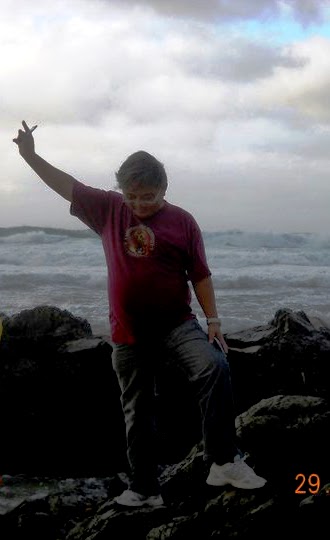
Huge rocks, anthills, and spots "where grass never grows" are believed to be haunted, except probably this one by the roaring sea in Pasuquin, Ilocos Norte, where the UP-shirted "napugot ken lumakay" author recently went to.
The same prohibition holds for any termite mound, Ramos says, "where a blade of grass never grows and a fallen leaf never lingers." Such a mound (called bunton in Ilocano; dalimahon in Isinay; punso in Tagalog) is believed to be the footstool of the pugot or the lanib. "It is also the favorite entrance and egress of the dwarfs into and out of their underground world."

Ramos also pictured the sinanlakay and sinanbaket -- semblances of an old man and an old woman, respectively. He said they are demons garbed in black clothes and haunted trees near cemeteries or deserted lots grown over with shrubs and trees.

The sinanlakay is said to sometimes wear a sutana (priest's clothing) and is thus alternatively called sinampade (semblance of a priest). In my childhood barrio, I recall my grandfather's farm help Manong Ilding came home trembling one very early morning and stammering with words that sounded like he saw a sinampadi leaning on a coconut trunk when he was sent to go fetch the carabao under a jackfruit grove. No matter how my Apong Lakay kept nudging him after that, the guy could not be made to go out alone in the dark anymore, more so in the vicinity of that old grove where he said he saw a priest.

Don't get the impression though that tree-dwelling spirits are the monopoly of Ilocano-speaking communities. A more recent book by the same author, The Creatures of Midnight (Ramos, 1990), lists about 85 such creatures scattered throughout the Philippine archipelago. Which means that aside from their Ilocano and Tagalog nomenclature, the creatures also have Zambal, Pangasinan, Ibanag, Bikol, Tausug, Visayan, and Zamboangan names. Interestingly, except for those believed to dwell in rivers, ponds, lagoons, and other aquatic ecosystems, majority of the creatures inventoried by Ramos either lived in or have something to do with trees or forests.

The belief in benevolent and maleficent spirits dwelling in Nature -- in trees, rocks, streams, forests, caves, and mountains -- is also said to be strong among the Manobo people of Central Mindanao. In an essay, the anthropologist E. Arsenio Manuel (1977) wrote that the Manuvu (or Manobo) have this belief due to their pervasive faith in the "duality of existence" -- that is, that the physical body has a spiritual double.

Manuel added that the Manuvu also believe in "superior gods and lesser deities who dwell in the skyworld and whose favors are sought for success in agricultural work, fishing, hunting, recovery from illness, or protection and victory in war."

Another case in point exists in the remote upland villages of Mankayan, Benguet. People there take precautions when they get near certain big rocks and deep portions of mountain streams (Michael Dapdapig, pers. com., 1995). Huge rocks are believed to be guarded by a tumungaw (unseen dweller) and deep parts of streams are said to harbor a pinten (a ghost that drowns unlucky bathers). Thus you must refrain from roughly stepping on or even touching big rocks. For the deep ban-aw, you must first warn the resident pinten by gently throwing pebbles on the water before you dip or swim.

Curiously, among today's relatively urbanized Filipinos, the belief in haunted areas still exists -- yes, even in what Sylvia Mayuga (1995) has termed "the stunted, monoxide-coated trees of Manila." A durable example is Balete Drive in Quezon City which, in addition to its actual line of balete trees, is said to be occasionally avoided by motorists on moonlit nights because of a white lady who becomes one's surprise passenger but later disappears when confronted.

In Jalajala, Rizal (across the Laguna Lake from Los Banos), the old folks of Barangay Pagkalinawan talk of their avoiding a mountain spring in the upper reaches of the village. According to my Forest Anthropology professor Daylinda Banzon-Cabanilla (pers. com., 1988), this is because the place is believed to be haunted by spirits "who have the power to increase or decrease the volume of water flowing out of the spring when provoked."

Somewhere in the northern edge of Narvacan, Ilocos Sur, is a hill called Bantay Tirad. Franklin Cabaluna (1977) writes that on the hill's slopes are luxuriant grasslands where deer and other game abound and where deep and perpetually gushing springs attract animals seeking watering holes. Townsfolk, especially hunters, are wary of the place, Cabaluna says, because it is believed to be "inhabited by nymphs and other enchanted creatures." Thus, for a time the folklore resulted in the area's pristine and wildlife-rich state.

To those who live in the Quezon-Laguna area, accounts of "mysterious coincidences" in the Dolores, Quezon part of the mythical Mount Banahaw must still be fresh. Of particular interest were the ones related to the electrification plans for Kinabuhayan, a famous pilgrimage site kept serene, tree-covered, and tourist-attractive by members of the Samahan Tres Persona Solo Dios. The mysteries include the "effective intercession of the DENR in the environmentalist people's protest against the cutting of trees by Meralco to pave way for posts and power cables -- after going to court and other such legal means of seeking redress proved futile" (Mayuga, 1995).

That was not the first time, however, that such "coincidence" occurred. Mayuga cited an account recorded in Fr. Vicente Marasigan's Banahaw Guru: Symbolic Deeds of Agapito Illustrisimo:

"In 1940... an increasing number of pilgrims and excursionists to Kinabuhayan spring had begun to show commercial possibilities that tempted a business syndicate well connected with the municipal and provincial governments to plan a swimming pool resort around the spring of Resurrection. Tres Persona, technically squatters on national park land, would have to go. Suddenly the spring dried up and returned after the plan was abandoned, flowing until 28 years later when the old plan was resurrected. Again, the same thing happened. That last time was 1968...."

"Since then, government and big business have left Kinabuhayan pretty much alone, even when 7,283 hectares of Banahaw watershed were handed over to NAPOCOR management by Marcos' P.D. 1111, creating the Makiling-Banahaw Geothermal Reservation in the energy crisis of the mid-70s."

-----
[Coming up next: "Beware of Trees with Fireflies!"]