Showing posts with label Gabaldon. Show all posts

Wednesday, August 31, 2011

More Gabaldon Memories

See what a single photo can do? Joe Latar's shot didn't only resurrect memories that would have otherwise been forgotten forever, it also sent me to dig some more on the subject -- and to keep in touch with friends and relatives.

This blog forms Part Three of an unintended series of posts on the Gabaldon building of Dupax el Sur, Nueva Vizcaya. (The first,  posted in March 2011, was titled  "Goodbye, Gabaldon, Goodbye." The second, immediately preceding this piece, carried the title "Gabaldon Memories.")


A PAGE FROM HISTORY
Here's what I found from the yellowing and brittle 11-page manuscript titled HISTORY AND CULTURAL LIFE OF DUPAX that my dear mother, Mrs. Magdalena Pudiquet Castro, found among the files of my late father, Vicente Mambear Castro:
  • 1898 -- November 19. The American Forces (Cavalry) entered the town without any resistance.
  • 1901 -- Don Mariano Cutaran was made the first president of Dupax by the Americans. The first school where English was taught was also organized and established.
  • 1915 -- President Genaro Evaristo began the construction of the Gabaldon building of the Dupax Elementary School. It was completed during the administration of Don Torcuato Albano. The building was destroyed during the war and was rebuilt with war damage funds from America.
  • 1927 -- Dupax was linked with the other towns of Nueva Vizcaya by better roads. This was largely due to the efforts of the then incumbent Governor Alfonso Castañeda who is from Dupax.
  • 1942 -- June 25. The people of Dupax first saw the Japanese Imperial Forces.
  • 1946 -- June 6. The American Liberation Forces arrived in Dupax. There were no more Japanese soldiers reached as the Japs escaped to the mountains during the raids conducted the months before.
So you see, the Gabaldon building was part and parcel of the history of Dupax. This goes without saying that the ladies and gentlemen and children of the Evaristo and Albano clans should feel proud that their family names were etched in immortality with the construction of that building. I'm also sure the children and grandchildren of the dozens if not hundreds of Isinay, Ilocano, Tagalog and American workers (including carpinteros, labradors, peons, and capatazes) who labored to put up the building also felt proud that at long last Dupax had its own public school.

But then again -- ayyu, ayyu (what a pity) -- as shown in the photos below (which I shot last March 12, 2011) that monument is no more!
Front view of the missing Gabaldon building.


Back view of where the Gabaldon used to be. The rain tree may now be 70 years old.

A BREEZE FROM THE PAST
From Brisbane, Australia, came this August 27 email which should represent the oldest personal recollection (unless an older one would come in soon) of how life was when Gabaldon was still the one and only elementary school in central Dupax:

How are you my Isinay friend? Hope you and your family are all fine. I saw in your Face book pictures and what really amazed me was the picture of the old Gabaldon building. I still remember those days during my childhood the things I went thru like in my studies, my childhood friends and my teachers. 

Speaking of teachers, I think I can still remember them mostly of which I presume have all passed away or some still with us. The teachers were the following:

Miss Boy, Miss Ambatali, Miss Cacacho, Miss Lopez, Mrs. Tating Fernandez, Mr. Imperial, Mr. Felix, Mrs. Magaway, Mr. Herminio Castro, Mr. Apolonio Latar, Mrs. Coloma, Mr. Coloma, and lastly Miss dela Cuesta my favorite teacher. She was a very pretty woman and the funny part was I was in love with her and when she left I even cried. I remember the day she left she was in this Rural Transit bus that passed by our house and she waved at me and I felt tears flowing from my eyes. 

Those were the days I will never forget.  Unga^ tay sirye bayaw ot dioy mot si gi^na lalo mo bavayi ri asaj on uwar lalo mo maserot. Hahaha.

If you recall the last time I mentioned I prefer to correspond thru email rather than Facebook because there are more things to say. Hope to hear from you. I hope I didn't bore you with this email. Regards and GOD BLESS. Alfonso C. Magalad


OF RECENT VINTAGE
As a sequel to the earlier selection I made of messages posted in the "Isinay Friends" of Facebook, these further exchanges may interest you:

Oh...God! I have not seen the building since I graduated from elementary... It is kinda' sad at the same time it brings a lot of memories. My Grade 6 class room (Miss Lolita Campus - adviser) was at the right hand side of the building just beside the boys' workshop building and later on was inhabited by the Philippine Army battalion? Can anyone remember that? God! I witnessed truckloads of dead bodies killed by the Army (presumably NPAs' daw). Those bodies were dumped on the ground waiting to be identified. This scene horrified me as a young kid and up to these days I can still vividly see it my mind. It eventually caused me not to eat for at least a week... HELL YEAH... I WAS VOMITING AT THAT TIME... This is one memory that I will never forget and never have forgotten... On the other hand... there were good memories, too but I will be running out of space if I had to start recalling all of it.Editha de Guzman

O Edith that is so true. The Army used to be stationed at the lone old building called the workshop and you are right, they did bring the dead bodies of the NPA in that building. Gee... what an experience! Benilda Castro Almorade

Why can't I remember that incident? I remember behind that great building were mango trees? Going downhill to the river where as Benilda mentioned we drag/carry our desks to clean.Teresita Castro Bunal

That lone building used to be the 'ayuyang' of mr cenon asuncion as he was then in charge of carpentry, gardening and what not. it was the very same building where lots of dead NPA were brought but not sure where the bodies were brought from the building. could it be that they were buried in that building? if so, andojlan deet banih sirin banda... ua tessie, i think you were in high school then.Benilda Castro Almorade

Yes, third year na si Ate Tessie noon at fourth year sina Nancy kasi may mga classmates siya na nagkaboyfirend ng mga sundalo. First year ako noon at friends ko mga NPA lalo na si Kumander Narsing which turned out later to be a DPA (Major yata ranggo niya sa AFP). Yung mga pinatay ng mga military e, in fairness pinapabendisyunan sa church habang nasa ibabaw ng 10 wheeler which we call "Logging truck" tapos dinadala sa sementeryo pero sa labas inililibing.Judith Castro Dial


Although it's gone, the Gabaldon bldg., which we consider now as a thing of the past, has stood the adversities of times and has left an imprint in our minds that we could forever cherish. As I am writing these lines, I can't help but tend to be emotional for this gone monumental structure that played a vital role together with our teachers in moulding us into what we are now, useful citizens of this nation.Nemesio C. Felix

Uwa Charles, my last year in Gabaldon was when in 3rd grade so i knew and have seen the works that the students have to undergo in their Industrial Arts subject. Luckily, i got transferred to Los Banos in my 4th grade. During that time i concluded that it was a laborious task that they have to do and i didn't want to experience the same and since my family moved to Laguna, then i guess, i was able to escape the impending hard labor. And let me just add that i still rmbr Apu Gorio Felix, Uwa Neming’s father, who was the principal during our time. Lots of memories that i will never forget as long as i live.Arnold F. Bombongan

That's true Arnold, and who will ever forget the most challenging activity of all especially if the teacher is not around: going under the Gabaldon building and look for little holes made by a certain insect which we call "sunud-sunod"? Once... you collected more or less 5 of that insect, that's already considered a big accomplishment. In layman's term, "mababaw ang kaligayahan natin" but it paid off. You see? it became a part of our good memory of the old Gabaldon Building.Judith Castro Dial

Hi manang Judith! Long time no see! I've been busy for a while but tonight i feel like talking to everybody, hahaha! O yes, you just reminded me of that, it's one of our favorite hobby during recess time, and sometimes we get carried away and forget it's almost time to go back to the room and guess! Be prepared for the punishment awaiting for you.Arnold F. Bombongan


MY TAKE ON THE MEMORIES
By way of temporarily capping the discussion, here's what I posted in Facebook:

Many thanks, inarun iiva on iinsan, for contributing to the memories of the Gabaldon building and vicinity. The recollections that the Industrial Arts building (yes, that's how it was called then) was once a "kuta" of the military (I guess it was the Task Force Lawin) and was a dumping place for the NPA fighters they killed are not only shocking but also new to me.

For all you know, that Industrial Arts building was also memorable to me. I first entered it when I was in Grade 5 and the intermediate grade pupils had a meeting where I was elected PRO with Daisy Galutera (or was it her brother and Grade 6 classmate Edgar?) as President. Neyyit tay sino^to sirye... in fact, I even didn't know what PRO meant and what the duties were, beyaw ot saon si imbotos da.

I remember Sir Cenon Asuncion (who was, peovos, nicknamed Pallek then) was in charge of the Industrial Arts building during my time and, probably because he was courting Ma'am Cording (Concordia Garcia, RIP) who was then teaching in Palob...otan and staying in my Pudiquet grandparents' house in I-iyo, he often assigned me as monitor (taga-release then taga-panat) of the carpentry and gardening tools used by Grade 5 and 6 pupils.

This means that, as a teacher's pet, I was often free from doing what my classmates then were required to do -- alimbawa na: 1) mamangbang si tuutu^ an pangittuan si posten si eyar siri as-asup Abannatan; 2) manlajari, mantaliling, mangkatam, on mamasaj si pa-repair urumar teachers an desks; 3) mangapyat project an dustpan boon ila ya sajar an tajtaj (silag in Ilocano; buri in Tagalog) fiber an omoy min eyan siri ittuan da Lajay Imong an Calacala; 4) mantamnang si maman-okke^ on pantanoman si le-e an payaw an danum nar ya mi^bus si panen si nuwang on tayo^toar siri solar da Ama Edo^ an Laccay; on 5) manubuj si cosmos flowers, Vietnam rose, gumamela, on de-e tay an nabovov-on an masetas siri ampi-theater garden an dioy si sajungon di Industrial Arts buildingar.

The building looks very different now from the one on whose right side I once had a sitaw (pole beans) plot that I went to weed and water even on Saturdays. I recall that even if I was not an attractive boy then (toy mango^ngot, nave^leng, on nais-isaw tay eyampay si Sarles an Castro sire), I was quite popular with the girls because of my gayya^ which they bought for 10 centavos per gomgom for use in their Home Economics cooking lessons under Mrs. Luisa Soriano!
-- Charlz Castro
 

Gabaldon Memories

At long last, we have a photograph of the Gabaldon building of the Dupax Central Elementary School a few years before it was pulverized by people who have a different sense of history!

The "whole-body" shot arrived by unexpected email from my cousin and classmate from grade school to high school, Jose C. Latar, along with these words: "Attached is the picture I took the last time I went to Dupax,  in August of 2001. I need to visit Dupax again. Please post in your blog."

I'm not sure if Joe intended it, but there is a happy coincidence here. Joe emailed the photo August 25, 2011. Note that the camera he used imprinted the date 8 22 '01 on the photo. Here:

Taken by Jose Castro Latar on August 22, 2001, this photo may be the last to show how the Gabaldon building looked. Built in 1915 when Genaro Evaristo was town President, this was where most Dupax residents learned to read and write.


As soon as I downloaded the picture, I posted it in the Isinay Group of my Facebook account with the following intro:

At last, a photo of how the old Gabaldon building where many Dupax citizens learned Reading, 'riting, and 'rithmetic! Unless somebody has another shot taken before this historic school was demolished, this photo taken almost 10 years ago by... Jose Castro Latar, a long-time resident in front of the Dupax Elementary School campus, should be the last and latest. Sayang... mayat tay otyan i-preserve tiyen ikwilan toy materiales fuertes di sementonar.

And almost immediately, I got this barrage of feedback:


Manong, this was the old building oh i miss this one reallyTessie de Guzman

Brings lots of childhood memories.Baybee Castro Almorade

Although i didn't graduate in my elem. here, the 1st 3 yrs brings back good memories to cherish. This is where our foundation was first laid out. Just to mention a few of my classmates, they are the Castro cousins Abeth and Emma, Engr Aida Asuncion, Judith Grutas, Roel Galutera, Malony Magaway, Marlon Bautista and sorry if i did not mention the others but they know who they are.Arnold Bombongan

I just can't forget all the good memories here, where every special program I'm always chosen as the star dancer in any dance program, and cleaning the classroom, or ground, enjoying the cooking or arts craft at the Home Economics with Mrs. Magaway, oh I love making the guava jelly or making papaya candies, crocheting or sewing. I missed those days and always treasure them in my memories.Joanna Evaristo Tomaneng

Based on the above photo I find the building still structurally fit. It only needs refurbishing like replacement of windows and maybe floors and doors and repainting as well. You're correct Insan Charles, sayang podda!Nemesio Felix

When I was little this building seemed so huge I can still recall our batang for cleaners, stripping the benches with lija (leaves are so coarse -- enough to strip dirts on the benches hahahahah! Gone are the days -- or put some wawini sa upuan ng kaaway mo and see how it tickles their behind. – Tessie de Guzman

We used to clean the blackboard with dahon ng patani and for the floor, we used banana leaves or tinunaw na kandila added with red jobus so that the floor looks clean and shiny... We also had to bring the desks at the abannatan and use sand to clean them... My teachers were Mrs Victoria Coloma, Ms Lolit Campos, Mrs Deusdedit Marquez, Mrs Aurora Abijay Reyes, Mrs Estela Fernandez, Ms Maxima Dauan (Mrs Galutera), Mr Elpidio Cia, Mr Cenon Asuncion, Mr Gregorio Felix the Principal, Mr Apolonio Latar, Mrs Luisa Soriano, Home Economics, Mrs Leonor Guiab, Mr Arreo... I could go on and on and on... We also used to bring bolos or walis tingting to clean the surroundings... We used to bake nutri bun and cooked bitso bitso and sell them around Dupax... There were no computers then and everything was done manuallyBaybee Castro Almorade

Ins, para pa tayong metro aid nung araw hahahahahaha pero its a nice training though disiplina, interaction, teamwork and many moreTess de Guzman

Oh...God! I have not seen the building since I graduated from elementary... it is kinda' sad at the same time it brings a lot of memories. My Grade 6 class room (Miss Lolita Campus -- adviser) was at the right hand side of the building just beside the boys' workshop building and later on was inhabited by the Philippine Army battalion? Can anyone remember that? God! I witnessed truckloads of dead bodies killed by the Army (presumably NPAs' daw). Those bodies were dumped on the ground waiting to be identified. This scene horrified me as a young kid and up to these days I can still vividly see it in my mind. It eventually caused me not to eat for at least a week... HELL YEAH... I WAS VOMITING AT THAT TIME...this is one memory that I will never forget and never have forgotten... On the other hand...there were good memories, too, but I will be running out of space if I had to start recalling all of it.Edith de Guzman 

I'm sure there would be some more reactions -- nay, bitter-sweet memories -- but I'd rather reserve them for the next posting. 

P.S. #1
For those of you who are visiting this blogsite for the first time, it would help as backgrounder if you read the older post titled "Goodbye, Gabaldon, Goodbye!" (please click March) then move on to the next post "More Gabaldon Memories".

P.S. #2
By the way, our generous photographer who sent this lucky and historic shot all the way from the USA is Joe Latar (jlatar@ceo.lacounty.gov) who turned 60 only last July. Those of you who went to grade school in the Gabaldon building in the 1950s to the 1960s will remember that the Latar family had a house right in front of the school gate. Most of the Latars are now in the US. Joe himself now lives in Los Angeles, California, and works with the Information Technology Service of the Chief Executive Office of the Los Angeles County.


Monday, March 21, 2011

Goodbye, Gabaldon, Goodbye!

Not a trace was left of the school where I first heard cicadas sing, where we used to mumble "Land of the Morning," where I learned to write "What I Did Last Vacation," where we learned Good Manners & Right Conduct while lining up for our share of "nonfat dry milk donated by the people of the United States of America," and where I experienced this thing called "puppy love" when I was in Grade 2


The Gabaldon I'm referring to here was the 9-classroom, single story, and cream-colored building that many senior and almost-senior citizens of Dupax del Sur of today certainly have gone to when they were in grade school. Were it still standing today, it could have looked very similar to the picture above of the well-preserved Gabaldon building of Guinayangan, Quezon, that I downloaded from the internet.

The Origin of Gabaldon

Up until recently I thought the word "Gabaldon" was the name for that particular spot of the town bounded by the Laccay and Bato^ lots on the north, the Galam and Latar residences and their adjoining solar on the east, the Benitez guava farm and a child-friendly small hill on the west, and the Abannatan creek on the south.

Through the internet, however, I learned the following:
  • Gabaldon refers to the school buildings built as part of the elementary school training given by the Thomasites, the first batch of American teachers sent to the Philippines aboard the MV Thomas during the American colonial regime; 
  • the blueprint of the Gabaldon Building was a complex containing nine classrooms, a library, a property room, a principal’s office and an assembly hall; and 
  • the buildings were called as such in honor of Assemblyman Isauro Gabaldon of Nueva Ecija who authored Act No. 1801 widely known as the Gabaldon Act that appropriated 1 million pesos between 1907 and 1915 for the construction of schoolhouses of strong materials all over the country.

Gabaldon Memories

Those who went to that one and only Gabaldon building of Dupax del Sur in the '50s up to the '90s would recall that the building then had wide windows made of Capiz shells. I recall the same type of window seemed to be the standard for old houses in Dupax in the 1950s. The roof was also of galvanized-iron sheets, not asbestos like the smaller pre-fab building that we later went to for our intermediate or Grades 5 and 6 classes.

When I was enrolled in Grade 1, the first room that I ever entered in that building was the one on the right. I remember our teacher then was Mrs. Suzon and for the couple of hours or so that I was in her class (before I got "nakalus" or weeded out for being under-aged), I can only remember her pointing to a framed photo of Jose Rizal above the blackboard while telling a story about the guy being shot in Luneta or something. We were too many in that room and the other kids were quite pushy and my little brain then could not quite understand why the fuzz about this Rizal. And so I was listless and preferred listening to the song of the cicadas on the mango tree that framed the right side of the Gabaldon.

Apart from the familiar wide stairway and the long signboard above it that carried the name DUPAX ELEMENTARY SCHOOL, there was a concrete flagpole in front that served as our "save" (meaning, point where one is already immune from being chased) each time we kids played hide-and-seek. When I was bigger, it was a favorite base for teams when we played the then popular game of  "Prisoner." That game as well as that flagpole did much to build our agility and skills not only in running but also in doing the kulkulepot (Isinay word for evading a chaser by running zigzag or from side to side).

I haven't seen kids playing Prisoner lately but, for the record, it consisted of two competing teams fielding runners to chase one another on the then wide open, foot-friendly and thickly grass-carpeted school yard of the Gabaldon. And whoever got touched by a chaser would become hostage or "prisoner" of the chaser's team. The prisoner could however be saved if his team would send one member to sneak up behind the enemy line and rescue him while one or two of his teammates are diverting the attention of the opposition's "soldiers."

I remember there used to be a bell near the door of the front room on the left. Made of a sawed-off World War 2 bomb (almost one-foot in diameter), that bell went "teng-teng-teng-teng" each morning that Mr. Julian Benter (during my time) pulled its string to signal that it was time for us mostly barefooted pupils then to stop running after one another in front of the building, and to fall in line in our respective grades and sections for the raising of the flag and singing of the "Land of the Morning" (yes, we used to sing the English version of the national anthem when I was in Grades 1 and 2), followed -- especially on Mondays -- by a pep talk on good manners and right conduct or other such themes by the Principal (at the time our Domang neighbor Mr. Andres Imperial).

That building certainly helped build the character of today's senior citizens of Dupax. It was where we learned to scrub the wooden floor with coconut husks, to pull stubborn grass such as the po-ot (amorseco; puriket in Ilocano), to sweep the yard of fallen leaves (yes, no plastic wrappers nor other such non-biodegradable litter then), and to fetch water in pails to flush the maggoty toilet bowls behind the building then -- things that many of us certainly did not do in our own houses!

It was also in the Gabaldon where we learned to be good Boy or Girl Scouts and not to push one another each time the "Non-fat Dry Milk Donated by the People of the United States of America" or other such foreign-to-local-taste goods as bulgur wheat, corn meal, cheese, and linseed oil arrived (I don't recall how) and we were asked to fall in line to receive our share. Whenever a classmate happened to have run out of grade school pad paper to form into cone as container for the powdered milk, he/she was always rescued by another who happens to have a thick pad.


Where's the Gabaldon?

I first learned that the Gabaldon building is no more from Mrs. Angelita Ponce-Luma'nga, sister of my Grade school classmate Luis Ponce whose house was near the elementary school, just across the stands of uhaw (a species of bamboo; bulo in Ilocano, boho in Tagalog; ) that formed one bank of the Abannatan brook. This was last January 15 when we went to the funeral of one of Mama's cousins, Uncle Antonio Pudiquet, who carried me on his shoulders when I was around 5 and we went for a picnic at the then still alive and sparkling Salinas Salt Spring (which Ilocanos or people in the area then called galpang).

Uwa Lita of course mentioned the sad news only casually. This was because she was excitedly contributing to the discussion with Mrs. Raza of now rarely used Isinay words among which were the following:
  • arehana (backyard; Ilocano arubayan)
  • galunggung (throat; Ilocano karabukob)
  • ilob-ah (to discard or reject; Ilocano ibelleng)
  • man-alinsaru (to sob; Ilocano agsaiddek)
  • manbinbiniwung (stay uninvolved in the corner; Tagalog magmukmok)
  • manbinbiniyu^ (adolescent woman; Ilocano balasitang; Tagalog dalagita)
  • misepsepat (join a conversation uninvited; Ilocano sumampitaw)
  • mise^se-ung (intrude into a conversation; Ilocano makisawsaw)
  • sumepaw (go over a fence; Ilocano lumaktaw)
  • tiyapong (gone astray; Ilocano bulakbul)
Mrs. Lumanga also animatedly recalled how, when she was in Grade 4, the boys spread wawini (Ilocano sabawil) fruit hair on the girls' desks and the resulting itch she got on her legs, buttocks and pubic area made her go careless in scratching affected parts including their tili-tili (Ilocano sellang; Tagalog singit), in the process raising her skirt like what the other girl victims did. But instead of punishing only the boys, Papa included the girls in receiving whips on the buttocks (or was it being hit with chalk and eraser projectiles?).

Not a Trace Left of Gabaldon

To verify the news, on our way home to Mama's house in Domang after the feast cum reunion that followed Uncle Anton's funeral, I asked my bayaw (brother in law) to let his van pass by the Dupax elementary school. And, indeed, I only saw a couple of goats grazing on the grass that overgrew in the spot where the mighty building once stood. Right then and there, I could only heave a sigh of sadness.

I went back there last March 12, almost two months after seeing the vacancy. What I discovered was not only emptiness but also signs of neglect if not lack of concern for campus maintenance. Naturally, what I saw did not only hit me like something was ripped out of my being; I also felt guilty for my not having been there when they totally obliterated my dear school.

Not only could I no longer associate the unkempt grass and gravel that I saw, with the cream-colored school that used to be my "home" when I was in Grade 2 (under then Miss Jovita Sanchez who held fort in the classroom main door on the right) and in Grade 3 (under then Miss Rosalina Gabriel, main door on the left).

Gone, too, was the flagpole that I never got to raise the Philippine flag on but which served as our "save" each time we played hide and seek when we got sudden breaks from classes each time the Principal (Mr. Andres Imperial) or the District Supervisor (a bald-headed round guy named Mr. Guiab) called our teachers to a meeting.

Indeed, not a trace is left of the school that heard me sing "Lend op di morning, seldi seldi serning... lend deer en holy dudu our sols ador!" All right, this was when it was not yet compulsory for public schools to sing the "Bayang Magiliw" (officially Lupang Hinirang).

Not one bit is also left of the wide building that saw me frequent Mrs. Cayetana Magaway's clinic for cleansing of the stubborn ga-te (scabies; gaddil in Ilocano) on my legs (which I recall I either acquired from too much climbing sapang (kararawit in Ilocano; lubalob in Tagalog; scientific name: Bridelia stipularis) and other such shrubs in Pitang for their fruits that I used as bullet for my kalido^do^ (bamboo toygun; palsuot in Ilocano; sumpak in Tagalog), or from riding carabaos in I-iyo with their hairy hide still wet from soaking in the river).

Not a bit of reminder also remained of my Grade 2 classroom where boys and girls were seated to keep them from making too much noise -- like what our teacher Miss Sanchez had done to me and a sweet-looking girl who I recall was at the time often wearing white sweater and went by the name Mercedes Perez.

Not one memento was also left of the building where in Grade 3 I cherished writing "My Pet Dog" and "What I Did Last Vacation" for my first English compositions under the Ilocana Miss Gabriel.

Not a dust also remains of the rooms that made me enjoy being a teacher's pet as a Grade 2 and as a Grade 3 pupil. (Well, hindsight tells me now I was that lucky not so much because I was doing well in class as because I happened to be the son of Mr. Vicente M. Castro, then a Grade 4 teacher; and that I was a nephew of other sirs and ma'ms like Uncle Ermin Castro, Uncle Cion Coloma, Uncle Polonio Latar, Auntie Tating Fernandez, and Auntie Toring Coloma.)

Not a shard remains of the wooden walls and floors and the GI roofs that were once silent witnesses when, as early as in Grade 2, I had this thing they called puppy love. (Bless her soul, the girl of my dreams then -- I heard the angels took her away one wintry day, only last December, most likely shivering, in a cold foreign land, and probably remembering!)


With the Gabaldon building gone, the school yard of Dupax Central Elementary School doesn't look like a school yard anymore. When I was little, this part of the 8-hectare campus was green with amorseco that we pupils often competed in pulling and which served as our playground for such 1960s games as "Prisoner of War," "innunungan" (wrestling) and "binnansiyan" (where one carried a partner on his back and used him to kick other pairs). At the time, a few meters from the gate (where this photo was shot March 12, 2011), one could already see the imposing figure of the building flanked by the Home Economics Building on the left and a round mango tree on the right that I never saw bear fruit but nevertheless had plenty of singing cicadas.

Call it a case of crying over spilled milk, but I do miss that old school for its having been part of my life when I was growing up. It was where I got to learn and practice my Isinay, where I made many friends among the Ilocano pupils from I-iyo, Manggayang and Bagumbayan, as well as gang-mates from among the Isinay-speaking guys on the central part of Dupax (not yet divided between Norte and Sur at the time).

The building also saw me bond with my father each election time even when I was already at St. Mary's High School and he would be one of the precinct leaders in the inner rooms of the Gabaldon, and I would bring him his lunch that Mama prepared and put in an aluminum lunch box.

There was also one evening Papa took me to watch the burning of old "condemned" books right near the flagpole and as we and the Latar boys watched the smoke billow from the bonfire, I could only feel sorry for those books that could have been given away to be read by my playmates in the barrio while keeping watch of their pregnant ricefields from marauding billit-tuleng (rice sparrows) or while waiting for their carabaos to finish their muddy pond wallow.

Gabaldon Photos, Anyone?

I don't know if somebody in Dupax has kept a "whole-body" picture of the school the way it was when I was small. Which was why when I asked my cousin Ninfa Castro-Tolentino if she happened to have a photo of it in her files and she said yes, I readily gobbled the photo below.

For, even if the picture only shows the concrete stairs of the building and part of a door that I can't even determine if it was one that led to the rooms on the left or the rooms on the right, I'm quite certain that I have walked up and down those stairs and went through that door many times before -- and long, long before the respective births of the bright-eyed kids (three of whom are my "forest products") in this historic photo (taken by Ninfa more than two decades ago).

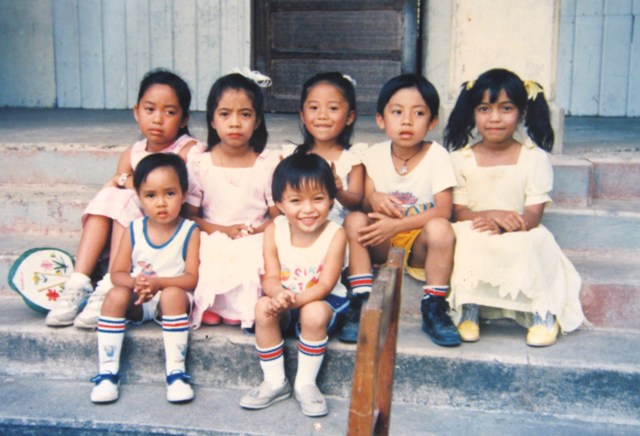
Taken circa 1988 at the stairs of the now-gone Gabaldon building of Dupax Elementary School -- Front row: Herbert Castro Tolentino and Enock Castro Dial. Second row (left to right): Minerva Fiadchongan Castro, Roselyn Castro Bañez, Leia Fiadchongan Castro, Charles Vincent Fiadchongan Castro, and Audrelyn Castro Bañez.

The Gabaldon was said to have been so termite-infested and earthquake-damaged the school authorities decided a couple of years back it had go. I don't know. But I do have this nagging feeling that those who call the shots for the demolition of school buildings and construction of new ones may have merely shifted more attention to the other school in the middle of the town, near the plaza -- the Governor Alfonso Castañeda Elementary School (GACES).

It's only a building, you might say. But not this building that was on our minds each time we sang this parody of Church in the Wildwood taught to us by Papa's cousin (and my Grade 6 teacher) Estela Guiab Fernandez:
There's a school in the valley by the wildwood
No lovelier place in the vale
No spot is so dear to my childhood
as the little cream school in the vale.

Indeed, the school was almost a girlfriend to me! And so, it is as if the following lines by the British poet and painter David Harkins are beamed in my direction:

You can shed tears that she is gone,
or you can smile because she has lived.
You can close your eyes and pray that she'll come back,
or you can open your eyes and see all she's left.
 Your heart can be empty because you can't see her,
or you can be full of the love you shared.
You can turn your back on tomorrow and live yesterday,
or you can be happy for tomorrow because of yesterday.
You can remember her only that she is gone,
or you can cherish her memory and let live on.
You can cry and close your mind, 
be empty and turn your back.
Or you can do what she'd want:
smile, open your eyes, love, and go on.