Showing posts with label Isinay. Show all posts

Tuesday, May 3, 2011

Isinay Songs: "Hymn for St. Vincent"

Note: Just got back from a week-long homecoming in Dupax (del Sur) to, among other things, attend the joint Patron Fiesta and Town Fiesta held April 27-30, 2011. The festivities started with a 45-minute procession around the main streets of Dupax followed by a mass at the St. Vincent Church officiated by Bishop Ramon Villena of the Diocese of Bayombong. Among the "gems" I was able to collect during this trip was a novena pamphlet containing the lyrics of one of the songs that my father always sang each time Dupax celebrated its patron fiesta. I suspected then that Papa just loved to sing this hymn (nawut in Isinay) because it was all about the Spanish saint after whom he was named. In this post, in toto and awaiting translation, are the wordings of the hymn.
 
Naut di San Vicentear
(Hymn for Saint Vincent)

1.
Uatoy siat patron min tua ot ammain tuar gloriamar,
San Vicente ypajogos daami toy mansor amit dadamar.

2.
Siri Espaniat osan bebeoy an Valenciar ngaronar
An sirir nianaamar mu impabautizo amos sin inmommoy
Mapear tua rien bebeoy, toy sirir nitajuanar.
San Vicente ypajogos daami toy mansor amit dadamar.

3.
Vicenter bautismomar, mangamis si atodajamar,
Ngaron die mipajna ysia toy ammair panarawum muar.
San Vicente ypajogos daami toy mansor amit dadamar.

4.
Ari siri aungamar la, ot impaulim mos mataju si osan ejao
Si impangibusuoy muar la wa bumangun a ayta amoy tat pan-escuelamar.
San Vicente ypajogos daami toy mansor amit dadamar.

5.
Uara mos si najanapan si simpiyu ta weyun taw-on ya in-eeng mur
Abiton Sto. Domingo de Guzman on toy sia mos si niamam dinapat mur inapiamar.
San Vicente ypajogos daami toy mansor amit dadamar.

6.
Osan diablos guet mardaj, babain immoy nanojso y-sia mu impabatar muar la
Ya inpapti mut manajtaj nanbuti di diablosar maspaj toy timaut si asdeamar.
San Vicente ypajogos daami toy mansor amit dadamar.

7.
Uean siat mansersermon, si baba an man Valencia mandonge on manpenitencia 
Di tajuaran nanbob-on mariran mirngue lan lojom toy nilossuang dar lom-anar.
San Vicente ypajogos daami toy mansor amit dadamar.

8.
Simpiu ta liman libu judios si nabautiswan da on weun libun moros payla
Toy uar tongtong muar on ynnu herejes alibulibun magaset casalananar.
San Vicente ypajogos daami toy mansor amit dadamar.

9.
Simpiu ta liman tinapay si inpaan muar tua si libun tajun mabua an niunur
Da y-sia, adday milagros mos tien amma-y si atdit urumar ynapiam.
San Vicente ypajogos daami toy mansor amit dadamar.

10. 
Osan babait nanpinsan toy nataje ot namatoy si ananar on nangui-oy
Siu lom-anar ta ysiram mu siri lat nampauliam matajun ynentregam si amanar.
San Vicente ypajogos daami toy mansor amit dadamar.

11.
Nanquing-quing a on nangompan si pangayaj mut man-atung nu neir masait si atung,
Si ynuriam diran uar atungar darin lom-an, binumti dat nancruzamar.
San Vicente ypajogos daami toy mansor amit dadamar.

12.
Uarat osan natoy babayi on ylubu da mos otia mu ympamangun mue
Ysiat osan linsangan ammai atdiona tutuwon yu at tajuar toy tueyan tuar ybajanar.
San Vicente ypajogos daami toy mansor amit dadamar.

13.
Ampaylamu siat dauay ya ansan di ynpanparirdirila mar si batang muar natilang,
Urum mi on natoy a adday ymmoy at viopar ymmoy toy sirin tua gloriamar.
San Vicente ypajogos daami toy mansor amit dadamar.


SOURCE: Novena to Saint Vincent Ferrer. Saint Vincent Ferrer Parish, Dupax del Sur, Nueva Vizcaya. 12 pp. 

Top photo: The statue of St. Vincent is being loaded with kids dressed as angels in preparation for the procession to kick off the celebration of the Dupax del Sur Patron Fiesta and Panlingalingan Festival 2011.  
Right photo: Here's how San Vicente Ferrer looks when the church is still dark and quiet. A larger statue occupies the topmost rung of the altar, immediately above the life-size replica of the crucified Christ. St. Vincent is always depicted as standing over a globe with his right index finger pointing skyward. (I have yet to research why.) Below: Devotees return to the church with the statue after the 45-minute procession along the main roads of the town (accompanied by musicians formed out of the remaining members of the St. Vincent Orchestra and playing the tune of the "Hymn for St. Vincent"). 

PHOTOS by Charlz Castro taken April 28, 2011


Monday, March 21, 2011

Goodbye, Gabaldon, Goodbye!

Not a trace was left of the school where I first heard cicadas sing, where we used to mumble "Land of the Morning," where I learned to write "What I Did Last Vacation," where we learned Good Manners & Right Conduct while lining up for our share of "nonfat dry milk donated by the people of the United States of America," and where I experienced this thing called "puppy love" when I was in Grade 2


The Gabaldon I'm referring to here was the 9-classroom, single story, and cream-colored building that many senior and almost-senior citizens of Dupax del Sur of today certainly have gone to when they were in grade school. Were it still standing today, it could have looked very similar to the picture above of the well-preserved Gabaldon building of Guinayangan, Quezon, that I downloaded from the internet.

The Origin of Gabaldon

Up until recently I thought the word "Gabaldon" was the name for that particular spot of the town bounded by the Laccay and Bato^ lots on the north, the Galam and Latar residences and their adjoining solar on the east, the Benitez guava farm and a child-friendly small hill on the west, and the Abannatan creek on the south.

Through the internet, however, I learned the following:
  • Gabaldon refers to the school buildings built as part of the elementary school training given by the Thomasites, the first batch of American teachers sent to the Philippines aboard the MV Thomas during the American colonial regime; 
  • the blueprint of the Gabaldon Building was a complex containing nine classrooms, a library, a property room, a principal’s office and an assembly hall; and 
  • the buildings were called as such in honor of Assemblyman Isauro Gabaldon of Nueva Ecija who authored Act No. 1801 widely known as the Gabaldon Act that appropriated 1 million pesos between 1907 and 1915 for the construction of schoolhouses of strong materials all over the country.

Gabaldon Memories

Those who went to that one and only Gabaldon building of Dupax del Sur in the '50s up to the '90s would recall that the building then had wide windows made of Capiz shells. I recall the same type of window seemed to be the standard for old houses in Dupax in the 1950s. The roof was also of galvanized-iron sheets, not asbestos like the smaller pre-fab building that we later went to for our intermediate or Grades 5 and 6 classes.

When I was enrolled in Grade 1, the first room that I ever entered in that building was the one on the right. I remember our teacher then was Mrs. Suzon and for the couple of hours or so that I was in her class (before I got "nakalus" or weeded out for being under-aged), I can only remember her pointing to a framed photo of Jose Rizal above the blackboard while telling a story about the guy being shot in Luneta or something. We were too many in that room and the other kids were quite pushy and my little brain then could not quite understand why the fuzz about this Rizal. And so I was listless and preferred listening to the song of the cicadas on the mango tree that framed the right side of the Gabaldon.

Apart from the familiar wide stairway and the long signboard above it that carried the name DUPAX ELEMENTARY SCHOOL, there was a concrete flagpole in front that served as our "save" (meaning, point where one is already immune from being chased) each time we kids played hide-and-seek. When I was bigger, it was a favorite base for teams when we played the then popular game of  "Prisoner." That game as well as that flagpole did much to build our agility and skills not only in running but also in doing the kulkulepot (Isinay word for evading a chaser by running zigzag or from side to side).

I haven't seen kids playing Prisoner lately but, for the record, it consisted of two competing teams fielding runners to chase one another on the then wide open, foot-friendly and thickly grass-carpeted school yard of the Gabaldon. And whoever got touched by a chaser would become hostage or "prisoner" of the chaser's team. The prisoner could however be saved if his team would send one member to sneak up behind the enemy line and rescue him while one or two of his teammates are diverting the attention of the opposition's "soldiers."

I remember there used to be a bell near the door of the front room on the left. Made of a sawed-off World War 2 bomb (almost one-foot in diameter), that bell went "teng-teng-teng-teng" each morning that Mr. Julian Benter (during my time) pulled its string to signal that it was time for us mostly barefooted pupils then to stop running after one another in front of the building, and to fall in line in our respective grades and sections for the raising of the flag and singing of the "Land of the Morning" (yes, we used to sing the English version of the national anthem when I was in Grades 1 and 2), followed -- especially on Mondays -- by a pep talk on good manners and right conduct or other such themes by the Principal (at the time our Domang neighbor Mr. Andres Imperial).

That building certainly helped build the character of today's senior citizens of Dupax. It was where we learned to scrub the wooden floor with coconut husks, to pull stubborn grass such as the po-ot (amorseco; puriket in Ilocano), to sweep the yard of fallen leaves (yes, no plastic wrappers nor other such non-biodegradable litter then), and to fetch water in pails to flush the maggoty toilet bowls behind the building then -- things that many of us certainly did not do in our own houses!

It was also in the Gabaldon where we learned to be good Boy or Girl Scouts and not to push one another each time the "Non-fat Dry Milk Donated by the People of the United States of America" or other such foreign-to-local-taste goods as bulgur wheat, corn meal, cheese, and linseed oil arrived (I don't recall how) and we were asked to fall in line to receive our share. Whenever a classmate happened to have run out of grade school pad paper to form into cone as container for the powdered milk, he/she was always rescued by another who happens to have a thick pad.


Where's the Gabaldon?

I first learned that the Gabaldon building is no more from Mrs. Angelita Ponce-Luma'nga, sister of my Grade school classmate Luis Ponce whose house was near the elementary school, just across the stands of uhaw (a species of bamboo; bulo in Ilocano, boho in Tagalog; ) that formed one bank of the Abannatan brook. This was last January 15 when we went to the funeral of one of Mama's cousins, Uncle Antonio Pudiquet, who carried me on his shoulders when I was around 5 and we went for a picnic at the then still alive and sparkling Salinas Salt Spring (which Ilocanos or people in the area then called galpang).

Uwa Lita of course mentioned the sad news only casually. This was because she was excitedly contributing to the discussion with Mrs. Raza of now rarely used Isinay words among which were the following:
  • arehana (backyard; Ilocano arubayan)
  • galunggung (throat; Ilocano karabukob)
  • ilob-ah (to discard or reject; Ilocano ibelleng)
  • man-alinsaru (to sob; Ilocano agsaiddek)
  • manbinbiniwung (stay uninvolved in the corner; Tagalog magmukmok)
  • manbinbiniyu^ (adolescent woman; Ilocano balasitang; Tagalog dalagita)
  • misepsepat (join a conversation uninvited; Ilocano sumampitaw)
  • mise^se-ung (intrude into a conversation; Ilocano makisawsaw)
  • sumepaw (go over a fence; Ilocano lumaktaw)
  • tiyapong (gone astray; Ilocano bulakbul)
Mrs. Lumanga also animatedly recalled how, when she was in Grade 4, the boys spread wawini (Ilocano sabawil) fruit hair on the girls' desks and the resulting itch she got on her legs, buttocks and pubic area made her go careless in scratching affected parts including their tili-tili (Ilocano sellang; Tagalog singit), in the process raising her skirt like what the other girl victims did. But instead of punishing only the boys, Papa included the girls in receiving whips on the buttocks (or was it being hit with chalk and eraser projectiles?).

Not a Trace Left of Gabaldon

To verify the news, on our way home to Mama's house in Domang after the feast cum reunion that followed Uncle Anton's funeral, I asked my bayaw (brother in law) to let his van pass by the Dupax elementary school. And, indeed, I only saw a couple of goats grazing on the grass that overgrew in the spot where the mighty building once stood. Right then and there, I could only heave a sigh of sadness.

I went back there last March 12, almost two months after seeing the vacancy. What I discovered was not only emptiness but also signs of neglect if not lack of concern for campus maintenance. Naturally, what I saw did not only hit me like something was ripped out of my being; I also felt guilty for my not having been there when they totally obliterated my dear school.

Not only could I no longer associate the unkempt grass and gravel that I saw, with the cream-colored school that used to be my "home" when I was in Grade 2 (under then Miss Jovita Sanchez who held fort in the classroom main door on the right) and in Grade 3 (under then Miss Rosalina Gabriel, main door on the left).

Gone, too, was the flagpole that I never got to raise the Philippine flag on but which served as our "save" each time we played hide and seek when we got sudden breaks from classes each time the Principal (Mr. Andres Imperial) or the District Supervisor (a bald-headed round guy named Mr. Guiab) called our teachers to a meeting.

Indeed, not a trace is left of the school that heard me sing "Lend op di morning, seldi seldi serning... lend deer en holy dudu our sols ador!" All right, this was when it was not yet compulsory for public schools to sing the "Bayang Magiliw" (officially Lupang Hinirang).

Not one bit is also left of the wide building that saw me frequent Mrs. Cayetana Magaway's clinic for cleansing of the stubborn ga-te (scabies; gaddil in Ilocano) on my legs (which I recall I either acquired from too much climbing sapang (kararawit in Ilocano; lubalob in Tagalog; scientific name: Bridelia stipularis) and other such shrubs in Pitang for their fruits that I used as bullet for my kalido^do^ (bamboo toygun; palsuot in Ilocano; sumpak in Tagalog), or from riding carabaos in I-iyo with their hairy hide still wet from soaking in the river).

Not a bit of reminder also remained of my Grade 2 classroom where boys and girls were seated to keep them from making too much noise -- like what our teacher Miss Sanchez had done to me and a sweet-looking girl who I recall was at the time often wearing white sweater and went by the name Mercedes Perez.

Not one memento was also left of the building where in Grade 3 I cherished writing "My Pet Dog" and "What I Did Last Vacation" for my first English compositions under the Ilocana Miss Gabriel.

Not a dust also remains of the rooms that made me enjoy being a teacher's pet as a Grade 2 and as a Grade 3 pupil. (Well, hindsight tells me now I was that lucky not so much because I was doing well in class as because I happened to be the son of Mr. Vicente M. Castro, then a Grade 4 teacher; and that I was a nephew of other sirs and ma'ms like Uncle Ermin Castro, Uncle Cion Coloma, Uncle Polonio Latar, Auntie Tating Fernandez, and Auntie Toring Coloma.)

Not a shard remains of the wooden walls and floors and the GI roofs that were once silent witnesses when, as early as in Grade 2, I had this thing they called puppy love. (Bless her soul, the girl of my dreams then -- I heard the angels took her away one wintry day, only last December, most likely shivering, in a cold foreign land, and probably remembering!)


With the Gabaldon building gone, the school yard of Dupax Central Elementary School doesn't look like a school yard anymore. When I was little, this part of the 8-hectare campus was green with amorseco that we pupils often competed in pulling and which served as our playground for such 1960s games as "Prisoner of War," "innunungan" (wrestling) and "binnansiyan" (where one carried a partner on his back and used him to kick other pairs). At the time, a few meters from the gate (where this photo was shot March 12, 2011), one could already see the imposing figure of the building flanked by the Home Economics Building on the left and a round mango tree on the right that I never saw bear fruit but nevertheless had plenty of singing cicadas.

Call it a case of crying over spilled milk, but I do miss that old school for its having been part of my life when I was growing up. It was where I got to learn and practice my Isinay, where I made many friends among the Ilocano pupils from I-iyo, Manggayang and Bagumbayan, as well as gang-mates from among the Isinay-speaking guys on the central part of Dupax (not yet divided between Norte and Sur at the time).

The building also saw me bond with my father each election time even when I was already at St. Mary's High School and he would be one of the precinct leaders in the inner rooms of the Gabaldon, and I would bring him his lunch that Mama prepared and put in an aluminum lunch box.

There was also one evening Papa took me to watch the burning of old "condemned" books right near the flagpole and as we and the Latar boys watched the smoke billow from the bonfire, I could only feel sorry for those books that could have been given away to be read by my playmates in the barrio while keeping watch of their pregnant ricefields from marauding billit-tuleng (rice sparrows) or while waiting for their carabaos to finish their muddy pond wallow.

Gabaldon Photos, Anyone?

I don't know if somebody in Dupax has kept a "whole-body" picture of the school the way it was when I was small. Which was why when I asked my cousin Ninfa Castro-Tolentino if she happened to have a photo of it in her files and she said yes, I readily gobbled the photo below.

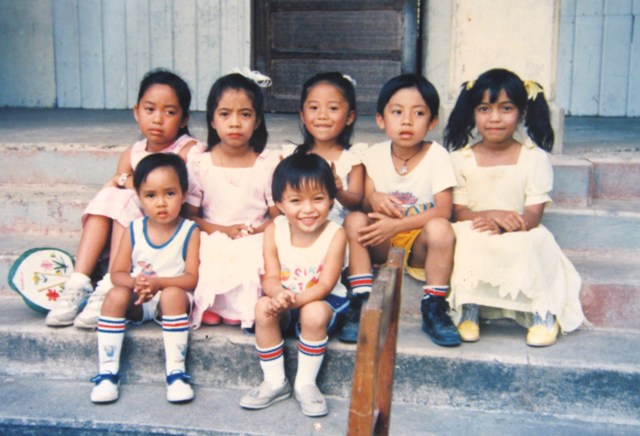
For, even if the picture only shows the concrete stairs of the building and part of a door that I can't even determine if it was one that led to the rooms on the left or the rooms on the right, I'm quite certain that I have walked up and down those stairs and went through that door many times before -- and long, long before the respective births of the bright-eyed kids (three of whom are my "forest products") in this historic photo (taken by Ninfa more than two decades ago).

Taken circa 1988 at the stairs of the now-gone Gabaldon building of Dupax Elementary School -- Front row: Herbert Castro Tolentino and Enock Castro Dial. Second row (left to right): Minerva Fiadchongan Castro, Roselyn Castro Bañez, Leia Fiadchongan Castro, Charles Vincent Fiadchongan Castro, and Audrelyn Castro Bañez.

The Gabaldon was said to have been so termite-infested and earthquake-damaged the school authorities decided a couple of years back it had go. I don't know. But I do have this nagging feeling that those who call the shots for the demolition of school buildings and construction of new ones may have merely shifted more attention to the other school in the middle of the town, near the plaza -- the Governor Alfonso Castañeda Elementary School (GACES).

It's only a building, you might say. But not this building that was on our minds each time we sang this parody of Church in the Wildwood taught to us by Papa's cousin (and my Grade 6 teacher) Estela Guiab Fernandez:
There's a school in the valley by the wildwood
No lovelier place in the vale
No spot is so dear to my childhood
as the little cream school in the vale.

Indeed, the school was almost a girlfriend to me! And so, it is as if the following lines by the British poet and painter David Harkins are beamed in my direction:

You can shed tears that she is gone,
or you can smile because she has lived.
You can close your eyes and pray that she'll come back,
or you can open your eyes and see all she's left.
 Your heart can be empty because you can't see her,
or you can be full of the love you shared.
You can turn your back on tomorrow and live yesterday,
or you can be happy for tomorrow because of yesterday.
You can remember her only that she is gone,
or you can cherish her memory and let live on.
You can cry and close your mind, 
be empty and turn your back.
Or you can do what she'd want:
smile, open your eyes, love, and go on.


Tuesday, February 8, 2011

“Sshhh… Keep Quiet and Don’t Go Under the Trees!”

BELIEF IN CRITICAL HOURS

NOTE: This is the third installment of my 1995 essay on folk beliefs associated with trees and forests that I sharpened a bit and retitled  “Of Fireflies and Forest Fairies” in the hope that its form and content, let alone its call for appreciating  indigenous knowledge systems and practices, would make for pleasant reading and not turn off visitors of http://isinay-bird.blogspot.com. Oh yes, if you have queries, complaints, suggestions, or whatever, you’re welcome anytime to prick my balloon via the comments section of this site or, if you are shy (like me), you can pour out some lines and send them to charlzcastro@gmail.com or charlz1951@yahoo.com.


M
any rural communities in the Philippines consider certain times of the day – usually high noon and twilight – as sacred and/or critical. During such hours, it is taboo to go outdoors, climb a tree, build a fire in the fields, throw rocks in the thickets, or engage in vigorous activities like chopping wood. 

The belief is that spirits are active and prone to doing harm to human beings, especially gallivanting kids, during those particular hours.

I recall how in my boyhood days in an upstream barrio of Dupax del Sur, Nueva Vizcaya, the womenfolk often warned us hyper-kinetic boys from straying too far from the village lest the kumaw (called sipay or manunupot in Tagalog) would get us, put us inside the langgotse (rice sack), bring us to a rangtay (bridge) being constructed in the towns of Bambang or Bayombong downstream, and use our blood as atang (food offering) to the spirits guarding the area, so that the bridge won’t easily be washed out when the Me-et or the Magat River went berserk during heavy rains. 

For some time that scare-tactic worked. And so at least, many a bayyek (tadpole) in the carabao pond, many a tuwwato (dragonfly) along the mountain trail, many a bambannagaw (chameleon) by the riverside, and many a pirruka (bulbul) in the bignay or the samak tree have been spared from some naughty kids’ itchy hands and from their slingshots’ raring-for-action mode. The deep parts of the river that we called lipnok similarly became quiet for a while as no right-minded fellow would go take a dip there without the company of big uncles.

Pretty soon, however, we noticed that the rusty trucks that we suspected to be those of the kumaw were hauling gigantic lawaan and bagtikan logs – not naughty kids – from the blue forests further upstream of the barrio. And pretty soon it was open season again for us mango-munching, bird-hunting and river-loving lads.

But then someone revived stories of the marmarna (roving spirits) or the di makitkita (unseen beings) who roamed aplenty at high noon.  Some of my Isinay relatives talked of seeing tiny footprints  –  believed to be that of the dwarf and long-haired lampong   – on carabao trails in hilly areas where not so many kids go. As if on cue, a couple of mysterious deaths of people we knew – one under a bitnong tree, another in his kaingin – also started to go around. It didn’t take long, indeed, before we kids  avoided engaging in raucous outdoor play again or using our ubiquitous slingshots during the hours that Ilocanos call agmatuon (namalintur in Isinay; literally “time when the sun is directly overhead”). 

I’m not sure if such a belief was intentionally nurtured to ensure peaceful and worry-free noontime siesta for the Hispanized farm folk. I suspect however that the warnings about diurnally active ghosts were also meant to give mango-owning neighbors – when the fruits are in season -- time out in guarding their heavily laden trees from slingshot-happy kids on perpetual search for ripe fruits to target. 

In retrospect, I tend to believe now that in my childhood the belief has somehow helped extend the expiry dates of certain birds, reptiles, and other wilderness creatures. 

Holy Week Blues

Photo from
http://www.swpc.noaa.gov/primer/primer.html
I don’t know how it is in other rural communities in the Philippine archipelago, but at least in southern Nueva Vizcaya, the enforcement of  the “noontime curfew” was  at its strictest during cuaresma or Lenten season.  For, indeed, it would not be only us malleable adolescents who would observe the ngilin (literally “fasting and abstinence”) but also our basi-loving uncles. If at all they would go out, it would only be to bring the carabao to the river, not to the kaingin.

Thus, no matter how the gurgling song of the clear and cool river was luring us... no matter how sweet it would be to run after the grasshoppers sunning by the side of the carabao grazing field... no matter how seductive were the love calls of the alimuken (bleeding-heart pigeon) or the “come and get me if you can” shrieks of the kilyawan (oriole), it was “stay where you are” command for us. 

For a couple of hours or so, even our enemy tsakuk (Philippine coucal) would have peace taunting us uncircumcized boys with its “kukukukuk… supput… supput” song as the good boys among us would hang our slingshots by the post and do our share in husking the corn, shelling the peanuts, drying the tobacco leaves, baby-sitting kid sisters, squashing the fleas of the dog, or shooing away the neighbor’s hen and her dozen chicks from ruining the newly sown tomato seeds.

If we happened to be in the uma or in the taltalon, we would be expected to have taken the carabaos to their favorite mudhole or bamboo-shaded “parking lot” by then. Then we would join our old folks in the kalapaw (farm hut) to while away the witching hour often by nursing one’s leech bites or squeezing out the thorn of the kwantung (spiny amaranth) lodged in somebody else’s foot. 

More often than not, while doing our “foot surgery” or corn-husking chores , we would get a generous dose or litany of reminders (almost always in reference to our Olympian slingshot skills) the likes of but not limited to: 

Why don’t you go after the uwak that raided the ripe papaya and banana, instead of the meatless, harmless and sweet-singing sitsitik? Why not pull the barsanga (a weed) or bain-bain (makahiya) off the upland rice patch in the uma instead of combing the hills all day for pugo nests? And why not learn how to make rama (fish aggregating bamboo-cum-river stone contraption) or weave pasiking (rattan backpack) instead of challenging the kids in the ballasiw (other side of the river) to a fight?”

The same curfew would be imposed at dusk when the night cicadas start to sing and it is time to inventory the chickens up in the tamarind or caimito trees and to kindle the dalikan (earthen stove) for supper. In case we needed to go out to urinate or to dump rubbish in the abandoned tupig pit, we would caution the spirits by saying “bari-bari…,” “kayu-kayu….” or “tabi-tabi…”

And when we would eat outdoors whether noon or dark, we would remember to invite the unseen beings who are guarding the place – river, big tree, mountain, farm – by saying “Mangantayo, apo…” (come, let’s eat)  or like what my grandfather himself had been mumbling, “Ne, bagiyo….” (hey, here’s your share). Failing to do such would invite the wrath of the guardian spirit and it would give you stomach ache or some such trouble.

In the Cordilleras

Prill-Brett (1986) relates a similar belief in critical hours among the Bontok Igorot: “There are designated times of the day, from 11 AM to noon and from 5:30 PM to 6:30 PM, that are believed to be dangerous for walking mountain trails. These designated times are dusk and the hottest part of the day, times when malevolent spirits that push people over the mountainsides are believed to be roaming around.”

Beliefs like that, Prill-Brett says, are based on the “assumption  that for activities there is a proper time and place to be observed and respected in order to be in harmony with the supernatural beings in the area.” The said belief is the Bontok’s way of structuring their relationships with the environment, since they perceive themselves to be sharing the land with these supernatural beings who hold them responsible for the stewardship of the land.

Looking back, it would appear now that many forest areas -- especially the Benguet pine (Pinus kesiya) remnants that go tinder-dry and fire-attractive in the sweltering months of March-May -- have been spared from despoliation as a positive result of the reprieve brought about by such belief in sacred and critical hours. 

If summed up over the years, those seemingly insignificant “idle times” or times spent doing nothing would have otherwise been used to engage in forms of spirit-harming activity like chopping down saleng trees for use in the fireplaces of Baguio and La Trinidad, or clearing runo-covered hillsides for growing cabbage, strawberry and snap beans.

(NEXT: Belief in Haunted Places. FORTHCOMING: Belief in Unfit or Disfavored Trees; What’s Next for Folk Beliefs?; Appendix: Isnegs Declare Lapat to Conserve Natural Resources)

Friday, January 21, 2011

Indigenous Toys of Dupax Boys

WHEN I WAS growing up in the fifties to the sixties, we boys in Dupax also had many toys. Unlike most if not all kids today, however, our toys were live animals (like turtles, dragonflies, and maybeetles) or were directly made of bamboo or gathered from the trees (like the fruit of the tibig) or crafted from discarded materials  (like sardine cans, slabs from the sawmill, flower sheaths of the betelnut palm).

Kalido`do`
We called this palsuot in Ilocano. Tagalog boys call it sumpak. It consists of about a foot of bamboo branch open on both ends for “barrel” and a “trigger” made of 3 o 5 inches of same diameter but equipped with a sturdy and polished stick enough in length and thickness to go through the hole of the barrel. The “bullets” would be any soft material that could be plugged on the top end of the barrel then pushed through to the other end. Bullets could be wet paper, kapok flower buds, herb leaves, and unripe fruits of sapang (karrarawit in Ilocano; lubalob in Tagalog; scientific name: Bridelia stipularis) [see photo]. To operate, push one bullet towards the end of the barrel, then put another at the top end. When you push this second bullet, the air inside the barrel is compressed and pushes the other bullet out of the other end, creating a PLOK or other such popping sound. Innovations include putting a broken off 7-Up or Coke bottle neck to make the popping sound louder. Some have a hole on the side with which to push a succession of bullets, thus getting a semblance of rapid fire. It is fun playing longest-distance shooting or war games with this toy – some kids take too long chewing bits of paper for bullet; others take too long pounding the bullet to allow for tighter air and thus stronger shoot.


Gargarusa
Made of flat oval cans of sardines, the big ones. I seldom see these types anymore, but earlier the common brand was Rosebowl; one time in Dupax, a brand carried the name NAMARCO. The tin cans were good feeding trays for dogs, drinking bowl for chickens, containers of laundry soap (Perla or Argo) along with wash cloths and is-isu (bubbur in Isinay, this is a smoothened river stone used for rubbing body dirt), and organizer for nails, screws, and other small objects. But we often gave our old folks a stiff competition because the tin cans made good trucks (we had no concept of cars then). We bore a hole on one end and attached a string to it which we used to pull the thing. Almost always, our trucks’ loads were stones, sand, dust (tapok), and even a kitten or puppy. I recall one time there were plenty of Atlas moth larvae (fat, green ones) and the dreaded atattaru (Isinay term for an itchy worm; igges a makabudo) and we loaded and played with them too. For variation, a sardine-can could be opened only a little over halfway such that it has its top lid on; we folded this lid to resemble the roof of a bulldozer or a truck. More enterprising kids attach small Liberty or Darigold evaporated milk cans for wheels.

Palsiit
This is the slingshot we call baris in Isinay (tirador in Tagalog). This was my favorite multipurpose toy when I was a boy so much so that I have become an expert in making it (although not necessarily in using it). Many a perfectly Y-shaped guava twigs were sacrificed for the handle (pakawan) which I would first hunt in Pitang’s wild guava groves then tie with buri (silag) leaves to keep them trained (as in a bonsai). When finally I get to buy rubber (lastiko) from the market at Malasin, I would cut the guava branch and carved the handle into the desired U-shaped thing. I was wary not to go for the wide open Y handle as other kids would laugh at you and call your slingshot sawak. One time my Uncle Carting "Pagalmiduran" Legazpi has managed to get an inner-tire-tube from the sawmill, he let me cut my own supply of rubbers. Using Mama’s sharp scissors that she kept in her Singer sewing machine, I would go to Uncle Carting’s house and snip narrow shreds of rubber for tying the main rubber to my U-shaped pakawan. I would later abandon using these black truck-tire material for the more classy, well-trimmed and colored lastiko in Malasin that cost 25 centavos per length. Oh yes, the thing would not be complete if you didn’t have a palalat or that leather thing you attached at the other end of the rubber and on which you would set the stone for propelling by the rubber. I also happened to have an endless supply of palalat in the form of Papa’s discarded leather shoes. Other kids would use discarded upper soles of their mother’s bakya, which was not often good material. My slingshots were so artful I would not be ashamed of using them on my neck, like rosary or necklace, each time I would go out of the house. Not once did I also annoy Mama because I would pilfer some of the rubber bands she used for her hair-curling (kulot) livelihood as their red or pink colors blended well with my red or green main bands. As for Papa, I got his ire once when I lent my palsiit to my favorite cousin and playmate Nelson who used it to hit our neighbor Salin Calacala one time they quarreled and Uncle Ermin got the slingshot and shred it to pieces with a bolo while giving Nelson a scolding. Other recollections: Papa would capture slingshots from his Grade 4 pupils and bring them home. But he would not necessarily give them to me as gift then as I preferred the ones I personally made; besides, I didn't like their odorous smell that we called meyangdur in Isinay (naangdod in Ilocano). My sister Judith would of course choose one and, because I was her idol at the time, she would also wear one on her neck the way she would often see me wear one like a necklace. However, I have no recollections of the tomboy that she was ever hitting a bird or a mango with her slingshot.

Daldalig
Called dalih-dalih in Isinay, this had many variations: one with a meter-long stick/pole just to push around with, another with a bird or butterfly carving at the end and their GI sheet wings are attached with wire to the wheel such that the wings flap if you pushed the thing. The dual purpose (for play and for water-fetching chores) consists of a 2-meter sturdy bamboo pole that had a handle bar and could carry another kid or a pail of water. Some have two wheels of tebbeg (a fig tree; tibig in Tagalog) fruits; others with wheels made of sawn ends of round poles/posts. The dual-purpose or heavy duty ones usually have one sturdy wheel made of chiseled wooden board big and durable enough to carry loads. You could use discarded wheels of kiddie bikes for wheel or even those of a wheelbarrow. I saw one equipped with “busina” made of a string at the end of which is a milk can; if you pulled the string, a sound is made.
Pusitsit
Much working like a water gun, this I usually made of the slender stems of the bulo (see photo below) that our elders discarded when they made garong (a huge bamboo basket used to store palay), this is simply a tube with the node left intact but with small hole on one end  and the other end opened to allow the entry of a stick with cloth coiled to it. The tube is filled with water which spurts into strong squirts when the pusher is pushed -- yes, it worked like a piston. We used this as toy when we bathed in the banawang (irrigation ditch) or when there was not much to do in the neighborhood and so we had all the time to play and chase the dogs and chickens and ducks in the whole neighborhood in I-iyo. If there were no dogs to chase (as they would often run for dear life in their langgotse beds under the ladders of houses when they see us terrorist barrio goons coming), we would use as target for our water guns a water-loving pig tied under a langka tree. Or we would compete as to how far the water from the nozzle reaches. Sometimes it goes up to10 meters.

Salbatan
A hollow bamboo tube made of the thin bulo (uhaw in Isinay; boho in Tagalog; scientific name: Schysostachium lumampao) bamboo. We polished the mouthpiece to prevent injury to our lips. Then we would find seeds of the bugayong vine and use it as bullet. No. sir, we didn’t use mungo beans and the like as we valued their use as food. To operate, you put one seed to the tip of your tongue, set it on the mouthpiece of the tube, then in a strong spewing action often with the sound of “pit-tuww” you hit the target you and your playmates fancied, like a sleeping dog or a hen with newly hatched chicks.

Torotot
This is the bamboo toy that most often comes out in December when I was young, particularly when the St. Vincent and the Eagle Swing orchestras have awakened the whole town with their marchy music to encourage them to attend the misa de gallo masses (from Dec. 16 to 24). This flute-like toy produces musical sound depending on what tune you blew it on. The life span of the torotot however is only a few hours or as long as the bamboo film that gives the sweet vibrating sound lasts. To make one such flute, you have to have a green or half-mature  bamboo branch with less than one-fourth inch hole and has one-inch diameter. Cut one lawas (biyas in Isinay; internode in English) about one foot long of the green bamboo branch and remove the nodes on both ends. Smoothen one end to form the mouthpiece then leave the other end as is. Using a sharp bolo, you carefully sliced off one side of the less than foot long bamboo with the intent to expose but intact and uninjured the white film that forms part of the core of the bamboo. If the film gets broken or punctured, the instrument will not make a sound. 

Kadang-kadang
The kadang-kadang is the bamboo stilt that was a favorite toy of both Ilocano and Isinay boys when I was going to school in Dupax Central. I don’t know how it started but word got around that a senior woman named Baket Ayang was mad at boys who passed by her house (Parucha’s house, before the Benitez) “aboard” such bamboo stilts. Pretty soon, a song to the tune of  Paul Anka’s “Diana” would be shouted by the more naughty boys with these words: “I’m so young ni Baket Ayang, iparitna ti kadang-kadang, aglayus ti karayan…” I was an expert in using this one and, imagining that there would soon be a kadang-kadang race during the fiesta, I practiced jumping onto the foothold of the stilts and race as fast as I could. I started with ones that had about  one-foot-high foot-holder and graduated to over two-feet-high items that made walking on muddy roads or crossing the river easy without wetting your legs. The tall ones also made us safe from dogs.

Palakapak
Called ta-i-tâ in Isinay, this instrument is called bamboo clapper in English. It is usually made during Good Friday and used  in place of church bells, that is, to announce the start of the Black Friday procession around town. In earlier times, it is said this instrument was used to warn the neighborhood of the arrival of pirates or visitors, while some farmers use it to drive away the swarms of sparrows that attack ripening rice grains with its "plak-plak-plak" noise that could be heard perhaps even a kilometer away specially at night when all is quiet. To make one palakapak, you have to select a well-seasoned bamboo or what they term in Isinay as neyamsan (natangkenan in Ilocano). Aside from making a more audible sound, this seasoned bamboo didn't break easily. Depending on your height, you can choose a bamboo pole a meter or more in length. The fatter the pole, the better. Then with a sharp bolo or better yet a hand saw, carve out about a foot-long hole on the nodal end of the pole taking extreme care so that the pole will not break. Carve out a similar foot-long hole on the other side of the first hole, then scrape the "wound" to remove sharp edges that may cut your fingers. Then turning now to the other end of the pole, get a sharp bolo and split the pole into exact halves until you reach the gaping foot-long pair of slits and making sure you don't totally split the pole into separate halves. After you've successfully freed your bolo from the pole, your bamboo clapper is now ready for use. You can hold the end of one side of the halved pole with one hand and the nodal end with another and proceed shaking the contraption the way you clap your hands. You can "clap" the halves into the sound made popular in the early 1960s that we called "Let's Go!" and went like this: "plak-plak... plak-pla..plak-plak... plak-plak!" -- CHARLZ CASTRO


Tuesday, January 18, 2011

Nourished by Bananas

I’M CURRENTLY working on the production of the very first dictionary of the vanishing Isinay language of Nueva Vizcaya (particularly Aritao, Bambang and Dupax) and each time a new entry emerges from the caverns of my mind, almost always my memory comes alive with images, sounds, tastes, people, places, and events associated with the word.


For instance, while I was thinking of the Isinay term for the Ilocano agpaluom (literally, "to make something ripe"), I thought of the bananas (and also the mangoes, anonas, jackfruits, and avocados) that we used to goad to ripe during those days when buying such was not yet in our household vocabulary.

Never mind that up to when I sat down to write this piece, I was not still contented with what I came up with, that is, “mampayutu” and “mampajinuj” – derived from “nayutu” and “najinuj” (which both means "ripe"). This is because, at least, the remembering brought back to life images of people who played big roles in my boyhood — like Inang (my maternal grandmother Feliza Pudiquet y Lacandazo), Apong (my maternal grandfather Pedro Pudiquet y Duldulao), Papa (Vicente Castro y Mambear), Juan Reyes (my favorite barber), Carlito and Carmelito Lacandazo (my deceased barrio playmates and uncle-cousins), and Bonifacio Campo (a muscular neighbor who Papa often relied on for carrying sacks of rice to the rice garanry that we called kamalig in Ilocano or e-yang in Isinay).

Yes, as a kid, I derived much nutrition from bananas. In my grandparents’ house in I-iyo, we used to have tumok, dippig, lakatan, gloria, immasukar, camarines and other such varieties that my indefatigable Apong and Inang raised in the lower part of their upland farm in Langka and some in their defunct and formerly kasoy-lined bangkag (rainfed farm; gitaw in Isinay) on the left side of the Palabotan Elementary School. I remember Inang had two large earthen jars (burnay in Ilocano; mawaga in Isinay) that she used as container to make the ripening of the bananas faster and even. Presumably bought from Ilocos and used earlier by Apong to brew sugarcane juice into basi (sugarcane wine flavored with fruits of the samak or binunga tree) when the dadapilan (carabao-powered sugar mill; pan-asotan in Isinay) owned by Uncle Berong Miranda was still operating, the burnay were perfect storage containers for bananas as they kept the heat well and they were impervious to rats. Inang would drop a couple of thumb-sized karburo (carbide) stones from Apong’s lampa (carbide-powered lamp used for fishing) and then cover the mouth of the burnay with banana leaves then keep the resulting lid in place by tying it with a strand of lapnit (dried bast fiber from the bark of the bitnong tree that is called tan-ag in Tagalog).

When I was still in the elementary grades at Gabaldon and even when I was at St. Mary’s High School, I would sneak into my grandparents house in I-iyo (we called it Surung then) each time I felt like going there. The bananas were a magnet to me that became easier to go to when Papa bought me a bulldog bicycle. Of course, I would bring home some for Mama and my sisters, but not after gorging on a whole sapad (bunch; sapar in Isinay) of the nutritious fruits that my doting grandmother allowed me to, even if the bananas were meant to be sold outside of Surung.

Lest you get the impression that we didn’t have bananas in the ili (poblacion or town center), particularly our house in Domang, let me tell that Papa and I spent countless hours of father-and-son bonding trying to grow some in the solar (fondly called Mangga by my sisters) when it was still arable enough for planting, among other crops, cowpeas (iris in Isinay, kardis in Ilocano), stringbeans (gayya^ in Isinay, utong in Ilocano, sitaw in Tagalog), mungbeans (betung in Isinay, balatong in Ilocano, munggo in Tagalog), eggplant (balaseno in Isinay, tarong in Ilocano, talong in Tagalog), and kamote (sweet potato). Papa’s favorite was the señorita (a banana variety that had small or bite-sitze and fit for kids and very sweet fruits). Uncle Ermin (Herminio Castro) also grew the same variety but also had gloria in his beautiful road-on-all-sides lot across our house, the one where the houses of Ellen and Ninfa now stand.

In Langka, we would know when bananas are ready to be harvested when the crow or raven (gayang in Isinay, uwak in Ilocano and Tagalog) hovered and made loud “kwak-kwak-kwak” among the banana groves. If Apong and Inang were busy in their other farms (such as in Palabutan and Arwat) or had their hands full with their tobacco leaves (aggatud and agtunus, no Isinay terms for these; I guess because Isinays didn't grow as much tobacco as the Ilocanos), the crows and the martines would beat them to the bananas.

Sometimes, the neighboring farmers would help themselves to the ripe ones but would later tell my grandparents about it in the spirit of being neighborly. Often we would have one or two bulig (bunil in Isinay; this is the whole set of fruits along with their “petiole” or “cob”) loaded in the kariton (carabao-powered cart) and we would bring these home to I-iyo. When I was around, it would be my chore, in addition to washing the dishes (manajpat in Isinay, aginnaw in Ilocano), to convert into sapad (bunch) the still green bananas. You could do this by using a sharp knife, but in my case my favorite was the tip of the panabas (huge knife or bolo) used for cleaning the ricefield dike (tambak in Ilocano; tamnang in Isinay) if not the barusok (iron-tipped dibble used for planting upland rice; called asad in Isinay).

Inang would next take over setting the bunches in the burnay (mawaga in Isinay) while I would dump the “cob” in the abandoned tupig pit converted into garbage pit. And then, depending on the time of the day, off to the river or the hills I would go, along with whoever friends in the village were around. A couple of days or so later, the bananas would start to ripen and, because my grandparents were so permissive to me then (which I observed was not the case with my cousins), I would be free to help myself with all the bananas I could stuff in my mouth.

IN THE HOUSE at Domang (I have to tell here that I had some kind of a "dual personality" then, living with my parents in the town on schooldays and staying in my grandparents' house in the barrio on weekends or during vacation from school), Mama and Papa had a different way of ripening bananas. Yes, correct, we did have some stands  in the solar and in the then backyard garden that we used to have in that spot where Mama’s house (also known as Tessie and Romy’s house) now stands.

I always took delight in doing the panagtebba of a banana "tree" (I’m a forester, so I have to be careful here). I forgot the Isinay and Tagalog terms for this activity, but it is simply involved the felling of a banana "plant" whose fruits are ready for harvest. The joy of doing the task simply stemmed from the fact that it would entitle me to whatever ripe fruits there would be in the whole bulig (all right, let’s use the term “bunch” for lack of proper English word). There would always at least be a couple or more of such ready-to-eat fruits in the bunch which I would share to any sister (at the time Baybee, Judith, Tessie, Arlyne, and the late Merlie) who would be around. But they would often not be around as it was either they were too busy with their girly plays or Mama scolded them if their dresses got stained with the banana’s fluid (stain is mansa in both Isinay and Ilocano, mantsa in Tagalog).

As always, I would also process the bananas into small bunches, taking care not to injure the fruits. Then Mama would bring out a carton box and place the banana bunches there and cover them with fresh madre cacao leaves before putting the box beside or atop the pile of firewood (itungu in Isinay, pagsungrod in Ilocano, panggatong in Tagalog) near the kitchen. By the way, the box we used to ripen the bananas usually was a discarded “pagikkan iti mureng” (place for putting soiled clothes) which originally was a grocery goods container box  from the Chinese merchant Co Peng in whose puwesto (stall) in the public market in Malasin my mama and I would regularly go to encash Papa’s tseke (paycheck; usually not more than 200 pesos, if my memory serves me right).

I have not yet told of my tales about the banana that could probably make it to Guinness' book of records for having the most number of seeds. We called such variety saba ti sunggo in Ilocano/Iluko and majanilan si araw in Isinay, which both mean either "monkey banana" or "banana suited for monkeys." But I have to park for now and save the other tales for separate postings later. -- CHARLZ CASTRO

Wednesday, January 12, 2011

Educated by Rivers


I recently developed a deep concern for rivers, particularly the small ones that technically others would call “streams” or “creeks.” In fact, sometime last year I tested how my fellow members in the Senior Foresters Google Group (srforester@googlegroups.com) would react to my observation that the Philippines has not been giving the attention that rivers deserved. “What good would healthy forests and watershed management be if the rivers that they feed with clean water would just be spoiled?” I asked.

I suggested that my alma mater, the UPLB College of Forestry and Natural Resources, would do well to give justice to the “Natural Resources” in its name by including rivers and lakes -- not only forests -- among its curricular, research, and development concerns. I also suggested that the DENR would probably be a sexier agency if it designated qualified personnel in its central and field offices to specifically look after the country’s rivers.

Apart from my well-received postings in the foresters’ e-group, I even articulated my emotions and aspirations for the country’s rivers in an essay that my friend Joey Austria (head of the DENR Special Concerns Office and National Vice President of the Society of Filipino Foresters) was so kind enough to include in the Souvenir Program that we labored to produce (1,000 copies) and distribute during the SFF National Convention and Forum held at the Dakak Resort in Dapitan City last November.

M
y concern for rivers had its roots in their having been part of my life as a child. Given the choice between school and river, I’d go for the latter then if it were only possible for kids then to go on living even without going to our reading, ‘riting and ‘rithmetic subjects.

The situation may be different with today’s over-accessorized but nature-starved children. But, as a boy, the rivers were my playground, day-care center and fast-food paradise all rolled into one. I encountered, tasted and got affected by more flora and fauna along the rivers than in the deep-blue mountain forests (said to be home then of the headhunting Ilongots) east of our barrio.

It was in the bamboo thickets and forest remnants by the river that I learned to identify courtesy of Ilocano land-tilling and forest-using uncles and grandparents such trees as anteng (antong in Isinay; pagsahingin in Tagalog), alukon (ame in Is.; himbabao in Tag.), bitnong (bitnung in Is.; tan-ag in Tag.), kallautit (kalutit in Is.; kalumpit in Tag.), appatut (achuete), tebbeg (lavay in Is.; tibig in Tag.), lupa (tu^bu in Is.; lipang kalabaw in Tag.), bittaog (bitaog), kaburaw (abuwew in Is.; kabuyaw in Tag.), pakak (antipolo), and samak (binunga in Tagalog; scientific name: Macaranga tanarius), the fruits of which my Apong Lakay used to gather to add flavor to and prolong the shelf life of his famous basi.

It was in the river that my cousins and I learned to identify edible flora, including my favorite ariwat and kitkitiwit (vines with edible fruits and young leaves). Woe to barrio kids then who could not distinguish the edible pako from the bitter ones, and who found ballaiba (balliba in Isinay, bulbulintik and tabtaba (bahase in Isinay), taratara and other river greens not up to their tastes!

During rainy season, we went to the river to comb their then still bushy banks not only for edible fern but also butinggan (wild button tomatoes; sometimes called butbutones in Ilocano), bamboo shoots (rabong in Ilocano; tumpup in Isinay; labong in Tagalog), edible fungi (kudet in Ilocano; urapping in Is.; tengang-daga in Tag.), tigi (imbayang in Is.; pongapong in Tag.; scientific name: Amorphophallus campanulatus), and mushroom (uong in Il; amabuvun in Is.; kabute in Tag.). In the dry season also when the rats or locusts would not leave us farm folk enough to harvest, we survived with karot (karut in Is.; nami in Tag.; kalot in Cebuano) that grew plenty by the riverside but were said to be poisonous if not sliced thinly then soaked in running river water before dried and cooked as rice substitute.

The rivers were where we ran to each time health personnel came to give us barrio folk vaccination. We also hid by the river when Tagalog-speaking guys came with huge sprayers on their backs to whitewash our huts with DDT. We were wary of such strangers because of the “stay home, don’t go out” tales our elders told us about kid-nappers (kumaw in Ilocano and Isinay; sipay in Laguna Tagalog; manunupot in Batangas Tagalog) out to catch naughty boys, put them inside sacks, cut their throats like what they do to chickens, and spill their blood to fortify a bridge being constructed somewhere downstream of the Magat River.

Armed with palsiit (slingshot; baris in Is.; tirador in Tag.), we frequented the rivers to try our Olympian skills at running barefoot (at times naked) after the wild ducks/mallards (papa in Ilocano; engah in Is.; papan in Tagalog and Bicol), and tukling in Il.; tikling in Tag.) that cavorted in the reedy portions.

When there was not much bangkag (vegetable farm), kaingin or ricefield work to do, we went to the river to make sarep (seyup in Isinay) which involves damming shallow portions and be able to gather bowlfuls or kalderofuls of river fish such as bunog (stone goby; sappilan in Is.; biyang-bato in Tag.), bukto (goby; guggur in Is.; biya in Tag.; pidyanga in Surigaonon), ar-aro (small carp; alalu in Is.; martiniko in Tag.), gurami, or akasit (crablet; ahasit in Is.; talangka in Tag.).

The more intrepid among us would scour the deeper parts with pana (speargun) and santol-wood antiparra (goggles) to get to the bigger tilapia, mudfish (also called “snakehead fish: in the USA; dalag in Il.; dalaj in Is.; dalag in Tag.) and occasional eel (igat or  kiwet in Ilocano; dalit in Isinay and Bontoc; palos in Tagalog).

We boys in the barrio often went to the river to sharpen our bolos (usually badang or lilit which were often dulled by years upon years of use  and thus discarded by our elders). We spent some time to look for flat stones to use as our sharpening blocks (pagasaan in Il.; pampaliran in Is.; hasaan in Tag.). Later, we would test our skills in using the knives to gather a dead branch or two for firewood to bring home as sort of good deed for the day (so that our parents would not scold us somuch and would allow us to go gallivanting by the river again the next day).

Most of the time, however, we vented our bolo-wielding skills on the ferns, reeds, or whatever vegetation that unfortunately caught our cruel fancy. On some occasions, especially when the bush we call sapang in Isinay (karrarawit in Ilocano) start to fruit, we would go cut choice branches of the spiny bamboo (kawayan in Ilocano; lamuan in Isinay; kawayan-tinik in Tagalog) and make them into a toy-gun of sorts we call palsuot in Ilocano (kalido^do^ in Isinay; sumpak in Tagalog). The green fruits of the sapang were perfect “bullets” for our bamboo guns the absence of which would make us resort to young buds of the cotton tree (kapasanglay in Il.; apos in Is.; kapok in Tag.) or put a sheet of used Grade School pad paper on our mouth and chew it till it becomes malleable enough to insert in the hole of our bamboo toy-gun.

T
he rivers were also our all-season swimming pools and we just loved to go out on the day-after of floods (aggravated by the forest-clearing and migration induced upriver by two logging concessions) to look for newly created lipnok (deep part of the river) or pual (spot made deep by an uprooted bamboo clump) to swim on. We would use a stranded log or bamboo for diving board or sometimes whatever carabao happened to be laying nearby. That was how I learned to do the daplat (flat stomach) dive and how to swim the bara-bara (free style) and the langoy-aso (dog-style).

We would go back again and again to such swimming holes and do other games – like pinnautan (literally “endurance”) which involved staying submerged in the water and whoever comes out last would be the winner. Some other days we would go there to test another skill we river-loving kids are supposed to be master of: spearfishing.

The rivers were also testing grounds for how brave we were at crossing their rapids during the rainy season or going to fetch water at night and passed by trees full of fireflies (kulalanti in Ilocano; i^irung  in Isinay; alitaptap in Tagalog; aninipot in Bisaya). The rivers were also our clinics when we had circumcision (kugit in Il. and Is.; tuli in Tag.) and needed privacy when we boiled young guava leaves (uggot ti bayabas in Il.; utlo^ si bayawas in Is.; talbos ng bayabas in Tag.) to clean our penis wounds.

In summer, the river banks would become noisy with cicadas (riyari in Ilocano; duluriyaw in Isinay; kuliglig in Tagalog) and our excited voices as we joined our aunts to gather the edible pearly eggs and nymphs of the tailor ant (abuos in Il.; eha in Is.; kara-kara in Tag.). Of course, summer would be that part of the year when birds such as the bulbul (pirruka in Il.; pinuu^ in Is.; pulangga in Tag.) would be at their noisiest especially when a bugnay tree (buhnay in Isinay; bignay in Tag.).

On other sunny days when I could not sequester my cousins from their peanut-, palay- or tobacco-drying chores, I would go to the river alone to make mini rice fields and irrigation canals. Sometimes I combed the shallow parts or the so-called “oxbow lakes” (nangalisan in Ilocano) to look for stranded shrimps (lagdaw in Il.; ahdaw in Is.; sugpo in Tag.) that almost always became my instant “jumping salad” as they went straight to my mouth with their legs and tails still wriggling.

Quite often though, I went there to escape from farm chores and to play with the  tadpoles (bayyek  in Il.; tohong in Is.; butete in Tag.) or to catch red dragonflies (tuwwato in Il.;  atittino in Is.; tutubi  in Tag.; alindahaw  in Bisaya) to feed my pet martines. I would also scour the river debris to collect forest seeds of all shapes – some marble-like, some star-shaped, some almond-sized – that I contributed for extra points to my elementary science teacher’s classroom display.

When the first rains of April come, the riversides would again be busy at twilight as we would compete with other farm folk in I-iyo in catching May beetle (abal-abal in Il.; e-ve in Is.; salagubang in Tag.). We would use a beetle attractant we call keddeng which is simply the bark of the bitnong tree soaked in smelly mud for weeks and then airdried and wrapped in old cloth to keep its smell strong. Oh, it was pure delight seeing the insects fly one by one and later in pairs towards the keddeng that we stretched between two poles or sometimes just entwined on a stick or twig! As alternative, we sometimes applied a thick dose of pomade on our hair and it would be fun seeing the beetles go around you like little airplanes flown by drunk pilots!

We placed the unfortunate beetles in bamboo tubes (tubong in Isinay and Ilocano) with corn cob for stopper and, later, over flickering kerosene lamp (kingke in Ilocano, Isinay and Tagalog; sometimes tibanglos in Batangas Tagalog), we would count how many we were able to catch. And what did we do with the beetles? Well, we used them to whet our entomophagous appetites. My grandmother fried them with little lard, salt, garlic and tomato and – presto – we had a high-protein viand for supper and there would often be enough left for breakfast! Of course, I would keep a couple or more of the beetles to use as toys or to show off with playmates the morning after.

Oh well, those were the good old days, my friend! Even as I wish I could live my life with sylvan rivers all over again, I pity boys and girls of today who no longer get to experience the countless joys of life close to Mother Nature. — CHARLZ CASTRO