Showing posts with label Folk Beliefs. Show all posts

Friday, February 25, 2011

Trees with Ghosts Who Love Women

[5th of a series on folk beliefs associated with trees and forests]

If you get to see certain patches of forest with large trees that appear incongruous or out of place in their generally tree-less or desolate surrounding, chances are that they have been spared from the logger’s axe or saved from being converted into farms due to the belief in unfit or disfavored trees.
Mangoes are certainly magnetic and saliva-inducing fruits be they ripe or green. But did you know that in some communities, single ladies are warned not to go near a big mango tree because it is believed to be the home of a spirit who loves to waylay unescorted women? In Thailand, too, house builders are cautioned not to use the wood from mango trees because it is believed to bring illness and bad luck to the house-owners.


A
s a young forester in the 1970s, I happened to be part of the UP Los Baños College of Forestry team of resource persons sent out to public elementary schools to teach teachers certain concepts about trees and forests. One of the things I loved to share -- and which almost always became eureka moments among the Grades 1 to 3 science teachers I handled in Metro Manila, Nueva Ecija, Mindoro, Lubang, Antique, Iloilo, and Cotabato -- was that of a grotesque tree that usually starts as a tiny dropping of a bird on the branch of another tree. 

The Tree-Killing Tree

That grotesque tree is the balete. 

Indeed, as a plant, the balete starts out as a bird dropping that with the aid of rain and sun soon becomes an epiphyte or a virtual orchid. Available moisture and leaf litter in its perch high up on the host tree would next make the plant turn into a vine that sprouts forth several roots that seem to race though very slowly towards the ground. 

Once anchored on soil, the said roots would next become fast-growing stems whose branches and secondary roots, though not exactly sucking the host tree’s blood, as it were, would soon join one another to wrap themselves tightly around the host tree’s trunk. 

As the years go by, the trunk of the host tree gets strangled slowly but surely by the parasite plant’s fast-growing and intertwining stems. Not only that. Its branches that once served as cradle to the parasite, protecting it from wind and the scorching sun, soon become smothered by huge ingrate branches.
And finally, despite valiant efforts to survive, the poor host tree withers and dies -- and its place under the sun taken over by a multi-stemmed and dreadful-looking tree they call strangler fig or balete.

But that’s not the end of our story. 

The balete would later become a huge and wide-trunked tree especially if no one would dare prune or thin its prop roots or nip the “aerial” ones in the tip. When the tree bears flowers, a lot of insects would be attracted – bees, butterflies, ants. When the fruits start to become crimson then purple, several kinds of birds would come feed of the seemingly endless supply of luscious figs. 

At night, people who happen to pass by the tree would get startled by the flapping of wings, the swaying of branches, the shower of falling figs, and tiny squeaking screams as the fruit bats they call paniki would come once darkness has set in, sometimes in pairs, at times in droves, to chew the ripe figs and in the process often jostling one another for vantage among the tree’s fruit-laden twigs.

This activity of nocturnal mammals on fruiting balete trees, the tree’s propensity to grow in Spanish-era churches and brick-cum-lime towers, and the imaginative add-on stories about white ladies, smoking kapre, horse-headed tikbalang, and forest fairies dwelling on their boughs, all contribute to making the balete a tree to avoid and let live.
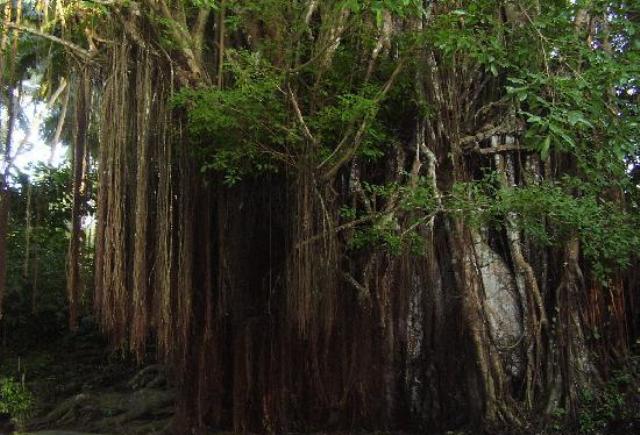
This old balete in Siquijor Island, Visayas, is believed to be enchanted. Note the hundreds of roots going down the ground, which in due time will become massive stems that strangle the host tree. Photo from http://www.tripadvisor.com/LocationPhotos-g664445-d1550106-Old_Enchanted_Balete_Tree-Siquijor_Visayas.html


But certainly the balete is not the only dreaded tree we have in the Philippines.

Other Haunted Trees

For obvious reasons, in many areas of the Philippines the most avoided trees apart from balete are century-old members of the following trees:
  •  Acacia (a.k.a. Raintree) -- Scientific name: Albizzia saman
  • Achuete (Appatot in Ilocano) -- Bixa orellana
  • Kalumpang (Bangar in Ilocano) – Sterculia foetida
  • Binuang – Octomeles sumatrana
  • Bitaog (a.k.a. Palo Maria) – Calophyllum innophylum
  • Bulala – Nephelium phippinensis
  • Mabolo (a.k.a. Kamagong) – Diospyros philippinensis
  • Mango –Mangifera indica
  • Narra – Pterocarpus indicus
  • Tamarind – Tamarindus indicus
  • Tuai – Biscofia javanica
Interestingly, they are avoided not as trees per se but more because of their big trunks, gnarled bark, mossy or lichen-covered branches, and dark cavities – all said to be indicators that they harbor malevolent spirits that one in his right mind should not disturb.

If these old trees happen to be found on the grounds of Spanish-period churches, the more that people would become wary of them. No one would dare cut them down unless exorcized by a priest. 

For instance, as a boy, I heard that when a large bangar/kalumpang tree in a church property was being felled to give space for a Netherlands-assisted piggery project, the handle of the axe being used broke several times even as the tree had a relatively soft trunk. It was only when the Dutch priest was asked to sprinkle holy water on the tree that the cutting went on smoothly. 

Trees Belonging to the Dead

Whether geriatric or not, no one would normally lay the axe or the chainsaw on trees growing in old cemeteries as they are said to be the playground or favorite siesta area of the ghosts of people who have not yet left their burial area. 

The same holds true for trees where somebody died or committed suicide. Also avoided are trees underneath which certain bodies, say Japanese soldiers or Filipino guerillas, have been buried. 

Such trees would easily become the subject of betting among gin-emboldened drinking buddies who would dare the supposedly bravest among them all to spend the night alone under their boughs or even take a nap under their shade during high noon when ghosts are said to be roaming.

Trees with Women-Loving Beings

There are trees whose “resident beings” are said to have a special liking to women. In the coastal towns of Western Pangasinan, for example, unmarried women are cautioned not to get near big mango trees especially if they are unescorted and if the trees are laden with fruit. Dante N. Pecson (pers. comm., 1990) says that in his hometown Agno, such mango trees are believed to be the hideout of the pugot, a male supernatural being that is said to have a strong penchant for  courting women and waylaying them for several days. Similarly avoided in the area are mabolo trees believed to be favorite shelters of hideous beings called lampong.

Trees with Chicken-Loving Guards

In the remote upland villages of Mankayan, Benguet, men and women alike are wary of the tree they locally call tiwwi (scientific name: Biscofia javanica; tuai in Tagalog; kanarem in Ilocano). Villagers are cautioned not to cut the tree or even urinate under it lest its tumungaw (guardian spirit) will be offended and will bring harm to the intruder. There have been persistent accounts of locals who fell ill for not observing this belief and who got freed from the tumungaw’s punishment only after their relatives made offerings of chicken and blankets (Michael Dapdapig, pers. comm., 1995).

This taboo imposed on the tuai tree probably explains why in many parts of the Cordilleras you get to see a number of several members of this broad-leaf species standing huge and tall among the needle-leaf pine trees. It certainly is more prudent to heed the warning of the elders rather than get sick and, equally bad, spend money for buying white chicken and a new blanket.

Trees Guarded by Fireflies

The presence of fireflies in trees has also proved useful in protecting their host trees from destruction. This is because fireflies (called kulalanti in Ilocano; i^irung in Isinay; aninipot in Cebuano; alitaptap in Tagalog) are often associated with a tree-dwelling diwata (fairy), engkantada (enchantress), or other such supernatural beings. Thus, trees that glow like Christmas trees with such tiny luminescent beetles at night are consciously avoided even during daytime.

Even the adjoining smaller trees and shrubs of such firefly-inhabited trees are often included as part of the taboo and are thefore off-limits to tree harmers. At times too, birds, lizards and other animals dwelling in them are secured from unnecessary disturbance.

Trees with Bad Character

There are of course certain trees that are spared by tree-cutters not because of the belief in the supernatural but more because of the so-called “bad” characteristics that such trees have. For example, in Agusan, newcomers used to wonder why there are giant trees (over 100 centimeters in diameter and taller than the tallest coconut palms) left standing like lone sentinels near the highway or in the middle of ricefields. 

These trees, called toog (Combretodendron quadrialatum), were unwittingly left there not so much because previous loggers adhered to some belief systems that warned against cutting the trees but more because such trees are considered “unfit” or “unwanted.” Indeed, mature toog trees contain huge amounts of sand like deposits in their wood that easily dull or bring rust axes and saws used on them. If by chance some foolhardy fellow is able to convert a toog log into lumber, the dried lumber is said to be super tough against nails and against ordinary carpentry tools.

Another example exists among firewood gatherers in Dupax del Sur, Nueva Vizcaya. In this case, trees belonging to the Leeaceae plant family are considered unsuitable for use as firewood, thus, who cut and bring them home to fuel the erathen stove are laughed. This is because the species – particularly the one we call ang-ang in Ilocano (mali-mali in Tagalog) brings nothing but ash and smoke. Worse, they are said to cause kettles and claypots to break.

In Kalinga and Apayao, firewood gatherers are also cautioned from hauling downhill wood of trees that, when used to cook rice, cause the rice to spoil easily and sometimes emit poisonous smoke (Henry Aliten, pers. comm., 1995).

Trees Struck by Lightning

Perhaps in defiance of the notion that lightning doesn’t strike twice, standing trees that had been struck by lightning are considered a symbol of bad luck and are therefore avoided or are not used as lumber especially for building houses no matter how good the quality of the tree’s wood would be. 

In some cases too, the place where the lightning-victim tree still stands is avoided because it is believed that the site is cursed and that lightning might strike it again.

Disfavored Trees in Thailand

Those of you who think that the beliefs I’m describing in this essay exist only in the Philippines would do well to know that people of one of our neighbor countries, Thailand, also share the same taboo as regards trees growing in burial grounds and trees hit by lightning. 

In addition, the Thais also believe in “unfit” or “disfavored” trees. An inventory of such trees was, in fact, done by Khon Kaen University researchers led by Dr. Pagarat Rathakette (1985) and their list included the following trees:
  • Po (Ficus religiosa) – Regarded as the most sacred tree in the eyes of Buddhists, it is considered sacrilegious to cut it.
  • Kabok (Irvingia malayana) – This tree’s local name means “not fulfilled” and, thus, its use is believed to cause poverty in the family.
  • Poey (Irvingia species) – A bitter-tasting tree, this is believed to bring bitterness in life to the family that uses it. The local Thai name means “naked” and so it may bring nothingness or emptiness to its users.
  • Ai (Ficus species) – Considered parasitic, this tree is said to lead its users to become dependent upon others for their living.
  • Loem (Canarium subulatum) – This tree is said to bring bad luck and illness to its users.
  • Ma Moung Paa (Mangifera indica) – This is the mango tree whose fruits are okay for eating; however, the use of its wood for housing is believed to bring bad luck and illness to the house-owner.
 --CHARLZ CASTRO

…[Next: What’s Next for Folk Beliefs?]...

Wednesday, February 16, 2011

Don't Step on the Anthill!

(4th of a Series on Folk Beliefs Related to Trees and Forests)

BELIEF IN HAUNTED PLACES

One can easily dismiss the age-old belief in ghosts, spirits, and supernatural beings as figments of imagination made tenable and palatable by generation after generation of telling and retelling as bedtime stories for children.

As it is, however, rural communities still harbor tales of groves and fields and other spots that are best avoided because of the ugly and sinister deities believed to dwell in them. Many geriatric trees and patches of wilderness areas are shoo-in items in this category -- and, because of such belief systems, they have been spared until recently from the logger's ax or from land speculators.

In his book Boyhood in Monsoon Country, the late essayist Maximo D. Ramos (1975) gave a list of the more popular creatures said to dwell in trees in the rural areas of Zambales. One is the kai-baan who is said to look "like a three-year-old child, has a fair skin, and a treasure of long hair flowing like corn silk," and chooses the bagbagutot shrub (Phyllanthus reticulatus) as its favorite abode. This fellow, according to Ramos, is said to be a generous friend but is quite vindictive when harmed by careless folk. "It is believed to be capable of causing sore eyes, a wry mouth, and black and blue spots on the skin."

Also mentioned by Ramos are the agbarbarangay who "sail in fleets at night, and anchor their boats to the top of large trees." These night creatures are said to invite whoever is brave enough to go for a ride on their barangay (boat), in exchange for becoming a medium who would be told specific wild roots or herbs to cure the village's common diseases, after which he would be left up in the tree where his folks would find him peacefully asleep the next day.

Other creatures Ramos described are the pugot (also called lanib or kapre), the santilmo (St. Elmo), the agkarkarison (ghost that rides on a cart), and a headless black creature that could assume a variety of sizes, from an infant to a giant the size of a big tree. Ramos writes: "These beings are said to do nothing but evil. The moment a man trespassed their haunts, they would try to frighten him out of his wits, or sometimes they would carry him up to the crotch of the tree they lived in and kill or leave him there."

For precautions against these tree-dwelling evil beings, Ramos says "the best thing to do is never to get near, much less touch, big trees with oblong leaves." He cited the feared strangler fig (more popularly called balete [Ficus balete]), the bangar (Sterculia foetida; kalumpang in Tagalog), and the bulala, and said these trees are the domicile of the kapre and pugot.

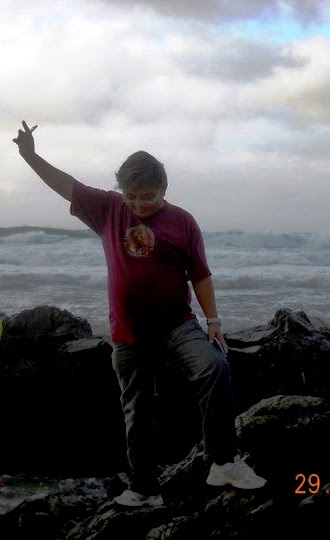
Huge rocks, anthills, and spots "where grass never grows" are believed to be haunted, except probably this one by the roaring sea in Pasuquin, Ilocos Norte, where the UP-shirted "napugot ken lumakay" author recently went to.
The same prohibition holds for any termite mound, Ramos says, "where a blade of grass never grows and a fallen leaf never lingers." Such a mound (called bunton in Ilocano; dalimahon in Isinay; punso in Tagalog) is believed to be the footstool of the pugot or the lanib. "It is also the favorite entrance and egress of the dwarfs into and out of their underground world."

Ramos also pictured the sinanlakay and sinanbaket -- semblances of an old man and an old woman, respectively. He said they are demons garbed in black clothes and haunted trees near cemeteries or deserted lots grown over with shrubs and trees.

The sinanlakay is said to sometimes wear a sutana (priest's clothing) and is thus alternatively called sinampade (semblance of a priest). In my childhood barrio, I recall my grandfather's farm help Manong Ilding came home trembling one very early morning and stammering with words that sounded like he saw a sinampadi leaning on a coconut trunk when he was sent to go fetch the carabao under a jackfruit grove. No matter how my Apong Lakay kept nudging him after that, the guy could not be made to go out alone in the dark anymore, more so in the vicinity of that old grove where he said he saw a priest.

Don't get the impression though that tree-dwelling spirits are the monopoly of Ilocano-speaking communities. A more recent book by the same author, The Creatures of Midnight (Ramos, 1990), lists about 85 such creatures scattered throughout the Philippine archipelago. Which means that aside from their Ilocano and Tagalog nomenclature, the creatures also have Zambal, Pangasinan, Ibanag, Bikol, Tausug, Visayan, and Zamboangan names. Interestingly, except for those believed to dwell in rivers, ponds, lagoons, and other aquatic ecosystems, majority of the creatures inventoried by Ramos either lived in or have something to do with trees or forests.

The belief in benevolent and maleficent spirits dwelling in Nature -- in trees, rocks, streams, forests, caves, and mountains -- is also said to be strong among the Manobo people of Central Mindanao. In an essay, the anthropologist E. Arsenio Manuel (1977) wrote that the Manuvu (or Manobo) have this belief due to their pervasive faith in the "duality of existence" -- that is, that the physical body has a spiritual double.

Manuel added that the Manuvu also believe in "superior gods and lesser deities who dwell in the skyworld and whose favors are sought for success in agricultural work, fishing, hunting, recovery from illness, or protection and victory in war."

Another case in point exists in the remote upland villages of Mankayan, Benguet. People there take precautions when they get near certain big rocks and deep portions of mountain streams (Michael Dapdapig, pers. com., 1995). Huge rocks are believed to be guarded by a tumungaw (unseen dweller) and deep parts of streams are said to harbor a pinten (a ghost that drowns unlucky bathers). Thus you must refrain from roughly stepping on or even touching big rocks. For the deep ban-aw, you must first warn the resident pinten by gently throwing pebbles on the water before you dip or swim.

Curiously, among today's relatively urbanized Filipinos, the belief in haunted areas still exists -- yes, even in what Sylvia Mayuga (1995) has termed "the stunted, monoxide-coated trees of Manila." A durable example is Balete Drive in Quezon City which, in addition to its actual line of balete trees, is said to be occasionally avoided by motorists on moonlit nights because of a white lady who becomes one's surprise passenger but later disappears when confronted.

In Jalajala, Rizal (across the Laguna Lake from Los Banos), the old folks of Barangay Pagkalinawan talk of their avoiding a mountain spring in the upper reaches of the village. According to my Forest Anthropology professor Daylinda Banzon-Cabanilla (pers. com., 1988), this is because the place is believed to be haunted by spirits "who have the power to increase or decrease the volume of water flowing out of the spring when provoked."

Somewhere in the northern edge of Narvacan, Ilocos Sur, is a hill called Bantay Tirad. Franklin Cabaluna (1977) writes that on the hill's slopes are luxuriant grasslands where deer and other game abound and where deep and perpetually gushing springs attract animals seeking watering holes. Townsfolk, especially hunters, are wary of the place, Cabaluna says, because it is believed to be "inhabited by nymphs and other enchanted creatures." Thus, for a time the folklore resulted in the area's pristine and wildlife-rich state.

To those who live in the Quezon-Laguna area, accounts of "mysterious coincidences" in the Dolores, Quezon part of the mythical Mount Banahaw must still be fresh. Of particular interest were the ones related to the electrification plans for Kinabuhayan, a famous pilgrimage site kept serene, tree-covered, and tourist-attractive by members of the Samahan Tres Persona Solo Dios. The mysteries include the "effective intercession of the DENR in the environmentalist people's protest against the cutting of trees by Meralco to pave way for posts and power cables -- after going to court and other such legal means of seeking redress proved futile" (Mayuga, 1995).

That was not the first time, however, that such "coincidence" occurred. Mayuga cited an account recorded in Fr. Vicente Marasigan's Banahaw Guru: Symbolic Deeds of Agapito Illustrisimo:

"In 1940... an increasing number of pilgrims and excursionists to Kinabuhayan spring had begun to show commercial possibilities that tempted a business syndicate well connected with the municipal and provincial governments to plan a swimming pool resort around the spring of Resurrection. Tres Persona, technically squatters on national park land, would have to go. Suddenly the spring dried up and returned after the plan was abandoned, flowing until 28 years later when the old plan was resurrected. Again, the same thing happened. That last time was 1968...."

"Since then, government and big business have left Kinabuhayan pretty much alone, even when 7,283 hectares of Banahaw watershed were handed over to NAPOCOR management by Marcos' P.D. 1111, creating the Makiling-Banahaw Geothermal Reservation in the energy crisis of the mid-70s."

-----
[Coming up next: "Beware of Trees with Fireflies!"]

Sunday, January 23, 2011

Of Fireflies and Forest Fairies (Part 1)

{Or Enchanted Trees, Sacred Groves and Forest Fairies: A Sampling
of Folk Beliefs Associated with Trees and Forests}

By CHARLES P. CASTRO

NOTE: This piece was originally written as a term paper on Environmental Communication at the UPLB Institute (now College) of Development Communication, then presented as a discussion paper in the Seminar-Workshop on the Application of Indigenous Knowledge Systems in Sustainable Upland Development held Oct. 17-19, 1995 at the UPLB College of Forestry, College, Laguna, Philippines. It was later published as a popular article in the Diliman Review, a quarterly journal (previously magazine) of the College of Arts and Letters, College of Social Sciences and Philosophy, and the College of Science in UP Diliman. At the time, I was serving as University Researcher at the UPLB Forestry Development Center and, on part-time basis, was taking graduate courses in Development Communication and Environmental Studies at the University of the Philippines Los Baños. I'm posting the essay here because it does not only say something about my Dupax childhood, it also puts on record my strong views about Nature and rural people. (The photo of fireflies amidst trees here was borrowed from http://www.firefly.org/firefly-pictures.html )

Add caption

WHEN WAS the last time you have seen fireflies?

Don’t look now but I started with this rhetorical question to plug on the idea that fireflies and folk beliefs have a number of things in common.

First is that we don’t see much of the two anymore.

In the case of fireflies, many bad things have happened to them – pollution in the air, for instance, then destruction of their habitat, disruption of their life cycles, and dwindling sources of whatever food it is that nurtures these insects.

As for folk beliefs, same problems – pollution by intrusive technology, destruction of the sites associated with their use, disruption of their fruitful existence by purveyors of miseducation, and diminishing number of nurturing believers and practitioners.

I also thought of fireflies because, just like much of our folk beliefs, they bring nostalgia. They evoke images of those sweet yesteryears when, yes, grass was green and roses were red and you and I were young and alive and there was beauty in the twinkling stars and paradise could be found underneath the friendly neighbor’s guava or mango trees.

When we get to see fireflies flickering and cavorting and swarming the way fireflies normally do atop some geriatric or flowering tamarind tree, we would believe among other things that they were the playmates of some invisible and supernatural friends. And, indeed, if you were alone and brave and in the middle of the night stared closely and long enough, the myriad of flickering tiny lights would morph into an evanescent yet quite distinct figure, the likes of the outline of a long-haired maiden clad in flowing white.

WHY THE CONCERN FOR FOLK BELIEFS

T
HERE ARE still remnants of the notion that folk beliefs and related indigenous knowledge systems and practices (IKSPs) have no scientific basis. Many of us belittle them as nothing but superstition and stupid concoctions fit for gullible dwellers in areas that have not been sufficiently reached by evangelizers, educators, and modernization.

Fortunately, there are local as well as international agencies working in the environment and natural resources sector that are showing keen interest on IKSPs to which folk beliefs belong. For example, the Rio Declaration explicitly calls for their respect and recognition. If this development means anything, it could only be the fact that we’re now realizing the immense value of this erstwhile ignored treasure trove of wisdom in improving life on Planet Earth and in increasing the chances of humans themselves to survive.

Yet the growing concern for IKSPs may have come a little late. For one thing, these nuggets of wisdom are rapidly vanishing, and frittering away beyond our reach and far beyond the enjoyment of our children. In other words, IKSPs are going… going… going… just like, well, the fireflies that formed magical moments in the youthful years of many of us who have been blessed to live during that era when kids were not yet Nature-starved.

Don’t ask me why this snapshot  appears biased for indigenous systems. I have been foraging and ruminating on belief systems and traditional practices for well over a decade now, partly because of my inclinations as a leaf-lover. And partly due to my involvement in social forestry and upland development where IKSPs should never be ignored.

So far, my distillations include the following:

1. Belief systems are “windows” that we could use to review our history as a country that is well endowed with natural resources – and to mend our environmentally disruptive ways. For instance, they could indicate that their originators and earlier advocates, the early Filipinos, did have very deep respect and love for Mother Earth or Inang Kalikasan.

According to Celso Roque (a pioneer of environmentalism in the Philippines), earlier Filipinos – such as the Ifugaos and the Kalingas of the Cordillera, the Maranaws and the Tausogs of Mindanao, and the swidden cultures of Mindoro and Palawan – have developed systems of ecological adaptation to their environment, and that some of these successful systems are still extant in the Philippines. In a paper presented in the First Seminar on Philippine Environmentalism (jointly sponsored by the FDC, DENR and PCARRD in 1988), Roque said:

“These systems of use and management of natural resources were learned through empirical testing over centuries of trial and error. While most of these have no basis in theoretical science, their merits have been demonstrated by the stability of the ecosystems that they worked. However, the most important feature of these indigenous systems is their total integration with the political economy of the society. The system of use of natural resources has become an indistinguishable component of a seamless cultural fabric.” (Roque, 1988)

2. Indigenous knowledge systems are pathways we could try in our search for ways by which human beings could live in harmony with God’s Creation and not subdue or exploit Nature for the sake of short-term material growth. They may be one golden key towards finding solutions and powerful allies to minimize, retard, forestall, ward off, or even annihilate humanity’s emerging nightmares, ranging from widespread famine and starvation, balding hills and festering fields,  and loss of species and biodiversity, to dying lakes and drying rivers, to destruction of the ozone layer, to acid rain… etc.

The Washington-based Worldwatch Institute noted this earlier in its On the Brink of Extinction: Conserving the Diversity of Life. A snippet from the booklet:

“Indigenous people in every tropical forest region have developed traditions of forest restoration and management but such traditional practices have not yet been systematically examined as a basis for sustainable development by growing populations, let alone a promising tool for conservation. The loss of such cultural knowledge could prove as costly as the loss of plant or animal species.” (Wolf, 1987)

3. Indigenous knowledge systems are reminders that indeed ordinary folks are also capable of extraordinary ideas and, along with their hinterland homes, can no longer be considered as unattractive backseat passengers in nation-building. Moreover, their continued presence may just be a blessing and a reminder for us who may have forgotten that conscientious scientists, academicians, researchers, development workers, and policy-makers have much to learn from them.

As the World Conservation Strategy (IUCN, 1980) puts it:

“Rural communities often have profound and detailed knowledge of the ecosystems and species with which they are in contact, and effective ways of ensuring they are used sustainably. Even when a community is growing in numbers and is clearly destroying a part of its environment, it should not be assumed that all this knowledge has disappeared or become invalid, or that the traditional ways of regulating use have atrophied.”

4. As bodies of knowledge, cultural beliefs and practices are largely related to the stewardship of the natural environment, are highly adaptive for improving human-environment interactions, and often play critical roles in determining behavioral patterns that, in turn, affect, modify, and regulate many interactions within the human ecosystem.

In the words of George Lovelace, an anthropologist who helped reorient people-focused forestry programs at the Food and Agriculture Organization of the United Nations (FAO):

“Belief systems help human societies understand the world in which they dwell as well as other worlds they may believe to exist, and help account for each society’s position and its members’ roles with respect to these worlds. Beliefs – and the ideas, emotions, and motivations that they generat – often serve as important stimuli for a wide range of human behavior that directly or indirectly affects the environment. Beliefs affect how humans position and organize themselves within, and with respect to, the landscape. They also affect human decisions to exploit, and how, when, and to what degrees these should be occupied or exploited.”

5. IKSPs are answers of rural people (including what some call “the barriotic folks” and the “Baroks and the Bartolas” in the boondocks) to: a) lack of government attention, b) dearth of extension workers, c) inaccessibility of development programs, d) scarcity of truly grassroots and remote-village-friendly civic organizations; and e) the Metro Manila-centric nature of many environmentalists.
……

(NEXT: Belief in the Divine Presence;  Belief in Sacred Sites. FORTHCOMING:  Belief in Critical Hours; Belief in Haunted Places; Belief in Unfit or Disfavored Trees; What’s Next for Folk Beliefs?; Appendix: Isnegs Declare Lapat to Conserve Natural Resources)

TO BE CONTINUED....