Showing posts with label nature education. Show all posts

Sunday, July 31, 2011

Remembering My Nature Teacher


Much of what I am now as a father, nature-lover, forester, farmer, and writer, I learned from my grandfather Pedro Pudiquet

Boy and grandfather at home in the fields of the Lord. (Drawn July 2011 by DANTE N. PECSON)

THAT A PICTURE indeed paints a thousand words is exemplified by the illustration here made by my fellow nature-appreciation preacher and bosom friend Dante N. Pecson who, for almost four decades, served as all-around artist, editor, student adviser, dormitory head, and faculty member at the UP Los Baños  College of Forestry and Natural Resources until he retired a few years back.

The picture was intended for an essay ("Katas ng Kagubatan ang Dugong Nananalaytay sa Aking Katauhan") to be included in the International Year of Forests issue of PFEC's Kapaligiran. But it happened that Dante sent this drawing within the vicinity of my late grandfather's birthday and so, for lack of a photo to depict how my old man was to me when he was still alive, I took the liberty of using it ala-first day of issue in this blog.

At Home with Nature

Yes, as shown in the picture, I shared my grandfather's appreciation, love, and reverence for the things of nature -- traits that over the years made themselves felt in my inclinations as a person and professional. Looking back at those years that he (of course, along with my grandmother) was nurturing me with the facts of life with other living things, great or small, I now realize I would not have been a better father, nature lover, forester, farmer, and writer (among other qualifications) had I not been their grandson.

No matter if he was a hunting, fishing, and foraging person himself, my grandfather was not of the abusive kind. Ordinarily, the sight of deer or wild pig tasting the camote or other such crops in a swidden farm would make many people salivate for a rifle or a trap with which to bag the animals the next time around. But not my grandfather.

Instead of grabbing a rock to take a chance at the forest creatures, he would merely soak in the sight of them nibbling at his crops, silently observe their feeding behavior, count which one had horns or had tusks, and see how many young ones there were. Some time later, such wildlife encounters would come in handy when villagers would converge on my grandparents' yard for basi and an inebriated braggart would overstretch his ugsa or alingo hunting tales.

Unlike the supposedly normal behavior, Apong was not one to grab get-rich-quick situations in one outing. On several occasions when we went fishing, for instance, he would let go a pregnant mudfish or let loose a small one. And before I could express my sense of loss, he would say in Ilocano: "Tapno adda pay paminduaan." (So that we could come back again.)

He also believed in the sacredness of life. A couple of times that he saw the trigger-happy kid in me aim my slingshot at any bird, dragonfly, tree, or even rock that caught my fancy, in his characteristic gentle voice he called my attention not to bother "dagiti di mangan-ano" (those who do you no harm).

One time we were fishing on a stream, we saw this orange-black-and-white-colored and pencil-sized snake sunning itself on a flat rock. Before my grandfather could say stop, I crushed the poor thing with a river stone. He merely said "Inan-ano mon?" (What have you done?) after that. But I felt his deep sense of sadness at what I did to the little, definitely harmless and beautiful creature.

My grandfather could have been a good jungle-survival adviser. He knew what plant and creature was meant for this and that. He knew which birds and insects dwelt or fed on this tree of that patch. During abal-abal (May beetle) season, he knew which part of the village had the best prospects for catching the insect. Just by looking at a part of the river, he knew if there was fish dwelling in it or not. When one showed a skin disease, he could prescribe a leaf for minimizing the ugliness.

They probably picked it from their parents or grandparents themselves, but both my grandparents somehow had a built-in almanac in their minds. They knew when it was going to rain just by looking at the clouds. They knew when it would be sunny the following day by the sound of a nocturnal bird. They knew there would be war or famine somewhere by the position of the crescent moon vis-a-vis the stars at night.

Even if he smoked a lot of rolled tobacco leaf as a farmer, my Apong Lakay did not succumb to the ill-effects of smoking. I'm now 60 as I write this but I bet I could not carry the same cavan of rice he used to haul at ease when he was more than my age. Looks-wise, he had grey hair but never went bald and never had a bulging tummy like what I now have (I should have told Dante about this). He didn't use a sarukod (walking cane) either; in fact, even when he was already in his eighties, he could still hike long distances to look for and bring home fallen coconut fronds that he made into brooms, or dried tree branches for firewood.

When my grandmother was not looking and even when she already passed away, my Apong would go on foot a couple of kilometers upstream of town with his tabukol (fish net) on his pasiking (wicker backpack) and come back in the afternoon with his catch of tilapia, catfish and mudfish to use as food for his cat.

A Belated Eulogy
If this post sounds like it has the elements of a funeral speech, it is. When my grandfather died at age 91, for some unmentionable reasons somebody got the privilege (or opportunity for public exposure, if you may) of delivering the eulogy for him.

I'm not crying over spilled milk. That was in 1998 yet.

But come to think of it, I was the eldest of his grandkids and was the one who practically served as house child and stayed longest with my Apong Lakay and my grandmother in their place in the barrio. I was the one for which he caught turtles and the water birds kebkeb and tukling for my playmates. I was the reason he would scour the rivers of I-iyo for fish and frogs from midnight till dawn, even when it rained, using a carbide-powered lampa.

Indeed, for much of my boyhood years, my Apong and I were like (pardon the comparison) Batman and Robin. The two figures are not far-fetched, as Apong always had this anahaw raincoat called labig (annanga to some Ilocanos; tajapiaw in Isinay) while I was this wide-eyed boy acting as his ever-loyal sidekick or always following on his heels.

One day you would see us riding tandem on a slow-moving carabao on the way to the ricefield. Another day you would find us hiking mountain trails in kaingin territory. Next time around we would be combing the rivers of upstream Dupax for fish and shrimps, roasting corn and broiling mudfish in the farm, or running after killer dogs that preyed on newly born calf in his small patch of hilly ranch.

It was from my mother and two uncles that I learned bits and pieces of my Apong Pedro's early life. Born August 1, 1906 in Agunnit, Dingras, Ilocos Norte, the young Pedro Duldulao Pudiquet never went to school. This was not his fault. The story goes that when Apong was a boy, his father didn't want him to go to school. It was probably because, like most farm-locked parents at the time, the elder Pudiquet didn't believe in what schools could do. It was probable too that Apong's father still harbored anti-Spanish feelings at the time. (My Uncle Atong said Pudiquet was originally Periquet. Apong's elders who were followers of Apo Gregorio Aglipay made the name-change to escape persecution by Spanish rulers after an abusive Spaniard in the Ilocos of early days was killed by a freedom-loving Periquet.)

Through sheer effort of his own, however, Apong became able to read Ilocano words and people's names. I don't recall him ever writing a letter unlike my grandmother, but he could at least print his own name. How he achieved basic literacy is a story worth telling to his great, great grandkids, particularly those who have no interest in studying.

It was said Pedro Pudiquet as a boy did envy those who were privileged to attend classes such as the cartilla (basic reading and writing education passed on by the Spanish colonialists). At the risk of getting whip lashes from his father if caught remiss in his tending their farm animals, for quite sometime after he has put the carabaos in his care to pasture, he would creep to the house where cartilla was being held, peep through the bamboo wall and listen to what the maestro was teaching, and using a bamboo stick for pencil and the ground for paper, he would copy what is written on the board.

Over the years, particularly when he got married to and had children with my literate grandmother Feliza Lacandazo (herself a Nueva Vizcaya migrant from Tagudin, Ilocos Sur), Apong improved his reading skills with the Bannawag, the weekly Ilocano magazine.

Lessons from Apong
Mama confided to me one time why her father seemed aloof in his dealing with his brothers- and sisters-in-law. Mama said that he acted that way as a consequence of his being looked down upon by his then more well-off in-laws, one of whom owned a calesa, the equivalent then of the passenger jeepney now. For his part, when Apong arrived in a caravan from Ilocos in the 1920s, he found work as a caminero (road-maintenance laborer) in the Almaguer and Indiana parts of Bambang, Nueva Vizcaya. That's how he met and married a kankanen-vendor named Feliza.

It appeared that Apong's road-maintenance job was at the time (and even up to now) considered a very lowly one. For this he was often ridiculed by his in-laws. Instead of fighting back, however, Apong took his being belittled as a challenge. Even as his kids were born in Bambang, he pulled pegs and sought greener pasture in neighboring Dupax -- away from the prying eyes of my grandmother's siblings.

It was from my grandfather that I came to believe it is never too old to learn new things. I heard him talk to my Inang Baket one time that he saw a unique knot in a forest vine and would return to to learn how to do the knot himself. Coming from one who was already an expert in making fishnets, roping cows and carabaos, and weaving rattan and bamboo basketry, I was surprised.

When I was in high school and Papa bought me a second-hand bulldog bike, Apong also bought one. He was already in his fifties then and never rode a bike before, so it must have taken him several evenings let alone bruises from spills to learn how to balance himself and pedal on one. Take this, when he finally learned to ride a bike, we even had impromptu  races on rough logging roads on the way to the farm or on a river fishing trip in the Mammayang, Langka and Nabetangan area.

It was from Apong also that I learned you could improve your lot if you spend your leisure time doing more worthwhile endeavors. Rain or shine, and often with a large cigar on his mouth, he always has things to get busy on. Even when listening to his favorite Ilocano drama on radio, his fingers were always doing something productive. Examples: Mending his fishnet or making one for my grandmother's batbateng (shrimp net). Twining and spooling lapnit (bast fiber of the bitnong tree). Splitting green bayog bamboo for bamban used to tie harvested rice panicles. Polishing rattan strips or weaving these into pasiking or labba.

Indeed, it seemed he got sick when he had nothing to put his hands, heart, and mind on. This was probably why, unlike many of his fellow farmers in I-iyo, he and his family (including us his grandchildren) were sort of better fed and happy. It was surprising how we seemed to always have lots of bananas, papayas, camote, tugi, corn, peanuts, and fish and rice -- and yet (I learned this later on) Apong didn't personally own the farms and ricelands he tilled. I realize now that he discovered one could grow crops in the riverbanks, flood plains, even hillsides -- for as long as you persevere enough to clear their tall grass cover, uproot stumps, and plow them ready for agriculture.

Even the rivers were an opportunity for "subsistence affluence" (a term I learned when I was working with the then fledgling social forestry program of the pre-Cory Aquino Bureau of Forest Development) that my Apong tapped -- but which his lesser-willed and perseverance-challenged barriomates ignored. Apong always had a dozen or so fish-aggregating contraptions (called rama in Ilocano; lajma in Isinay) in the rivers of I-iyo that almost always became the envy of passersby who would see him and my grandmother (or me and my cousins and uncles) happily scooping out the mudfish, tilapia, bukto, bunog, jumping shrimps, and river crabs from the tabukol used to haul the river goods that sought shelter in the rama.

I'm thinking now: how come it was only my grandfather who had those rama at the time when all one needed was to collect large river stones, assemble them into a circular mound on knee-deep water, then cover the contraption with also free and abundant bamboo branches? How come he seemed to be the only guy in the village (perhaps even in the whole town) who always had a tabukol for catching fish?

I think the dots can now be connected to form a picture. And among the dots I now get to see via hindsight are contained in the following event I had with Apong:

One time I was with him on his kariton (carabao-drawn cart) to have sacks of irik (unhusked rice) milled in the kiskisan (rice mill), we passed by a group of barriomates (including a couple of his in-laws) enjoying their time seated on the siesta swing of the municipal judge's house. Apong's words still ring in my mind's ear: "Dika tultuladen dagita a nakamasngaad... Kitaem, no ania ti tugawda iti agsapa, isunto pay laeng ti tugawda no lumneken ni apo init." (Don't ever follow the ways of those idlers... Look, they sit that way in the morning, and they stay that way when the sun sets.)

Monday, June 13, 2011

From Firewood Gatherer to Forester

W
hen I went to Dupax last May, I brought my daughter Leia and my sister Arlyne’s grandkids to get a feel of the school and the hills that used to be part of my stomping grounds as a boy. From their looks and shrieks, and notwithstanding the mud on their sandals and the tingle of cogon blades on their juvenile skins, the kids did have fun and agreed we'd go further uphill next time I’d be home.

Little did my little hiking companions know, however, that I was also having the time of my life reminiscing those days when, to borrow a line from the Brothers Four’s song: “It was so good to be young then… to be close to the earth.”

One particular thing that made my heart jump a little was when we chanced at a father and two sons coming down the grassy slope of the mountain carrying on their shoulders what to me were very familiar things -- poles to be cut and split into firewood!

Firewood gatherers of Mt. Abuwew. [May 27, 2011 photo by charlzcastro]
Using almost the same trail that I trod perhaps more than a hundred times before, the trio jolted to life an almost forgotten chapter of my life’s story: When I was growing up in the Isinay territory of Dupax in the 1960s, one of my favorite chores was gathering dried poles and branches in the remnant forests of Mount Abuwew which I would later disijon or basijon (split with axe) into firewood.

The activity was a joyful thing to do on weekends and certainly during the school break in summer. It enriched my off-school days to such an extent that when vacation was coming to an end, I was looking forward to either compare notes with my classmates or do my English theme writing on the topic "What I Did Last Vacation." In fact, if there was an assignment that I loved doing when I could not run to my grandparents’ house in I-iyo and be with my Ilocano friends and fellow river lovers and carabao riders, it was gathering firewood.

Called mangayu in both Isinay and Ilocano, firewood-gathering  was to me a "turtle’s punishment" (as in Rizal’s story of The Monkey and the Turtle) for at least three reasons:

First, being the eldest and the only boy in the family, I was expected to do more household chores than my sisters after me when my mother was busy either sewing or washing clothes. This therefore meant that gathering firewood made me sort of exempted from such responsibilities as cooking the rice, bathing the pigs, washing the dishes, and baby-sitting kid sisters. And so I was free to eat whatever wild or communal fruits were in season – bayawas, sompalo, anunas, mangga, sarisay, sapang, arusip, bujnay, kamiring, lumbuy, kitkitiwit, majanilan si araw – without feeling guilty that I didn't share them with my sisters.

Second, firewood-gathering meant going out there in the wilderness of Mount Abuwew west of the Dupax Central Elementary School (or occasionally in the woods near the Dupax Subsidiary Nursery upstream of Abannatan) and use the activity as pretext so I could spend many hours running after the birds with my baris (slingshot; palsi-it in Ilocano), finding tulin (rice sparrow; billit-tuleng in Ilocano) nests in the cogonal areas, waiting for ripe and at times naam-amon (maggoty) mangoes to fall down from their twigs up in the big tree, and testing how my ota^ (bolo; buneng in Ilocano) would go against the giyun (cogon; pan-aw in Ilocano) and wawini (sabawil in Ilocano) that obstructed the trail. And when the soy-ang (sun) was too hot, I would lay down under the lirum (shade) of an arusip tree, listen to the duluriyaw (cicada), the titit (sunbird) and the pinuu^ (bulbul) sing in the forest glades, then probably doze off for a few minutes.When it rained, it was fun running to the  tangngej (tanglag in Ilocano) to make a cave-like structure as shelter, then later watch the tabungeyon (rainbow) on the other side of the valley.

And third, engaging in this exclusive-for-boys activity made me somewhat a bigger boy. For it required one to bravely hack a way into the eyas (forest) to get at a dead tree, climb and haul down a dried-up panga (branch), use skills at tying the poles and branches thus gathered with wa-aj (vine), and then sa^bat (carry on the shoulder) the heavy bundle of wood a couple of kilometers pabujibuj (downslope) and over maro-ot (grassy/bushy) trails. I would only stop to catch my breath while feasting my eyes on the panoramic scene of Dupax downhill.

T
here was no discounting the risks involved. Out there you were on your own. Out there you had to be wary of the alaksiyot (wasps/hornets; alumpipinig in Ilocano) and the abubbulij (a large stinging ant called ampipit in Ilocano). Out there you had to always be on the lookout for the venomous immanuy (spitting cobra), the ayatungan (green pit viper; dahong-palay in Tagalog), or the ine^eyaddang (python; beklat in Ilocano). In case you accidentally cut your limbs while bucking or trimming timber, the most that your couple or so of equally young companions could do was to go run and shout for help kilometers away.

Getting arms and legs bruised by suwit (thorns) and sharp-edged blades of grass were normal.  Getting paltus (callus; kapuyo in Ilocano) on your palms as a result of constant cutting of wood was also par for the course, in much the same manner that cases of naburuwan (acquiring skin allergy; nabuduan in Ilocano) as a result of getting in contact with the atattaru (itchy larva), plus getting matoler (stung; masilud in Ilocano) by the alaksiyot (wasp; alumpipinig in Ilocano), nipped by the e-ja (tailor ant; abuos in Ilocano), or malurun (mapurisan in Ilocano) were also part and parcel of the territory.

Not only that. Occasionally you got to encounter a mavungot (prone to anger) homestead or kaingin owner. And no matter how you swore innocence, no matter if you showed incontrovertible evidence that you went near his area only to find the tiktikrubung (sparrow) you shot down, you get shouted at with something like: “Gaddemet… da^yut manger-eraw si abukado on mangga!” (Goddammit… you avocado and mango thieves!)

F
ast forward a little to when I was a student in the UPLB College of Forestry. I realize now that my firewood-gathering days (not to mention my bird-sniping, tree-climbing, kaingin-farming and river-fishing experiences) were a fitting prelude to my pursuing the B.S. in Forestry (major in Forest Resources Management).

I really didn’t dream to become a forester. In fact, when I was in my senior year at St. Mary's High School, I wanted instead to be a journalist, inspired by a note along that line on my souvenir book by my English Literature and Grammar teacher, Madam Ermelinda Castañeda-Magalad. Our parish priest at the time, Father Theo Bonarius, also thought I would be a good candidate for the priesthood.

But it turned out that an increasing number of Isinays were then going into the profession called Forestry. I didn't know them very well then, but I heard such names as Vicente Magno, Omer Laccay, Sixto Badua, Segundino Laccay, and Rogelio Felix as having gone to take up Forestry in the University of the Philippines at Los Baños.

At the time, the logging industry was the top dollar-earner for the Philippines, rivaled only now and then by the sugar industry. At the time, there was a noisy sawmill across the sementeryo in Santa Maria, north of Domang, where every hour or so logging trucks would go to unload gigantic dipterocarp logs hauled downhill from the Ilongot territory in the blue hills upstream of Banila and Carolotan.

And so it came to pass that superior orders mandated that I go to forestry school. And because it was never my sweet dream to be a logger or to have anything to do with strangers who cut giant narra, apitong, lauan and bagtikan trees into isahan, dalawahan, and tatluhan logs (and whose bulldozers and logging trucks came to destroy and muddy the river in I-iyo where I loved to go spearfishing), I merely tried to keep my nose above the academic cesspool. I merely contented floating thru college life like in a dream, tried to make sense of my UP life by joining the student movement to awaken the Filipino people to the -isms that make life difficult for the country. And the rest I left to my lucky stars.

Ayyu-ayyu ra Ente^ on Dalen Castro! (What a pity for Vic and Maggie Castro!) No matter if they felt my inner rebellion against having been forced to take a course I didn’t have a heart for, they still went on scraping the little they could so I would become a UP-produced forester.

Looking back now, it could have been worse.

Had I not used as "wind beneath my wings" those wondrous days of my youth as a firewood-gatherer in the hills of Dupax, I could have called it quits to what I considered then as an uninteresting yet difficult course. I would not have loved volunteering to climb trees in my Forest Dendrology classes and chop the bark of some for easier species identification (using the same bolo I used to cut firewood back home). I would not have enjoyed, too, my Silviculture and Forest Nursery laboratory sessions, as well as my Summer classes where we cooked out, measured hundreds of trees, visited kaingin farms, and hiked a lot to and from the Mudspring area and up to the leech-rich peaks of Mount Makiling.

Put another way, had my firewood-gathering days not made me immune to the stings and scratches of student life, had my carrying heavy loads not made me spiritually and physically strong inside, and had not my discovery that freedom had a twin called responsibility, I would have stopped struggling to pass my courses.

Instead, I would have gone full-time in the activist movement or probably ran away to a place far from Los Baños and Dupax, found a wage-earning job as an upland farmer or fisher or whatever on a coastal village somewhere in Mindoro or Quezon or Bicol, and got a barriotic maiden for a wife with whom I could watch the tallivung (full moon) by the sea and share my rainbow-colored fantasies as a country boy.

In other words: Neyyi otyan charlz castro an mansulsulat si attun sutsur! (There would have been no charlz castro writing this kind of story now!)

Wednesday, February 16, 2011

Don't Step on the Anthill!

(4th of a Series on Folk Beliefs Related to Trees and Forests)

BELIEF IN HAUNTED PLACES

One can easily dismiss the age-old belief in ghosts, spirits, and supernatural beings as figments of imagination made tenable and palatable by generation after generation of telling and retelling as bedtime stories for children.

As it is, however, rural communities still harbor tales of groves and fields and other spots that are best avoided because of the ugly and sinister deities believed to dwell in them. Many geriatric trees and patches of wilderness areas are shoo-in items in this category -- and, because of such belief systems, they have been spared until recently from the logger's ax or from land speculators.

In his book Boyhood in Monsoon Country, the late essayist Maximo D. Ramos (1975) gave a list of the more popular creatures said to dwell in trees in the rural areas of Zambales. One is the kai-baan who is said to look "like a three-year-old child, has a fair skin, and a treasure of long hair flowing like corn silk," and chooses the bagbagutot shrub (Phyllanthus reticulatus) as its favorite abode. This fellow, according to Ramos, is said to be a generous friend but is quite vindictive when harmed by careless folk. "It is believed to be capable of causing sore eyes, a wry mouth, and black and blue spots on the skin."

Also mentioned by Ramos are the agbarbarangay who "sail in fleets at night, and anchor their boats to the top of large trees." These night creatures are said to invite whoever is brave enough to go for a ride on their barangay (boat), in exchange for becoming a medium who would be told specific wild roots or herbs to cure the village's common diseases, after which he would be left up in the tree where his folks would find him peacefully asleep the next day.

Other creatures Ramos described are the pugot (also called lanib or kapre), the santilmo (St. Elmo), the agkarkarison (ghost that rides on a cart), and a headless black creature that could assume a variety of sizes, from an infant to a giant the size of a big tree. Ramos writes: "These beings are said to do nothing but evil. The moment a man trespassed their haunts, they would try to frighten him out of his wits, or sometimes they would carry him up to the crotch of the tree they lived in and kill or leave him there."

For precautions against these tree-dwelling evil beings, Ramos says "the best thing to do is never to get near, much less touch, big trees with oblong leaves." He cited the feared strangler fig (more popularly called balete [Ficus balete]), the bangar (Sterculia foetida; kalumpang in Tagalog), and the bulala, and said these trees are the domicile of the kapre and pugot.

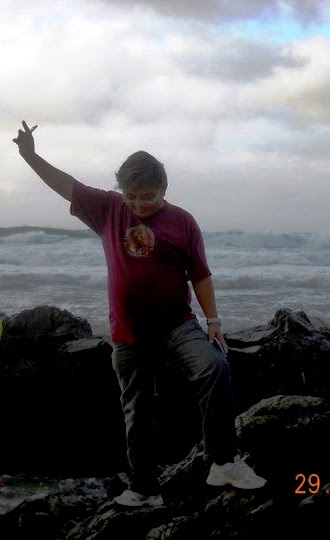
Huge rocks, anthills, and spots "where grass never grows" are believed to be haunted, except probably this one by the roaring sea in Pasuquin, Ilocos Norte, where the UP-shirted "napugot ken lumakay" author recently went to.
The same prohibition holds for any termite mound, Ramos says, "where a blade of grass never grows and a fallen leaf never lingers." Such a mound (called bunton in Ilocano; dalimahon in Isinay; punso in Tagalog) is believed to be the footstool of the pugot or the lanib. "It is also the favorite entrance and egress of the dwarfs into and out of their underground world."

Ramos also pictured the sinanlakay and sinanbaket -- semblances of an old man and an old woman, respectively. He said they are demons garbed in black clothes and haunted trees near cemeteries or deserted lots grown over with shrubs and trees.

The sinanlakay is said to sometimes wear a sutana (priest's clothing) and is thus alternatively called sinampade (semblance of a priest). In my childhood barrio, I recall my grandfather's farm help Manong Ilding came home trembling one very early morning and stammering with words that sounded like he saw a sinampadi leaning on a coconut trunk when he was sent to go fetch the carabao under a jackfruit grove. No matter how my Apong Lakay kept nudging him after that, the guy could not be made to go out alone in the dark anymore, more so in the vicinity of that old grove where he said he saw a priest.

Don't get the impression though that tree-dwelling spirits are the monopoly of Ilocano-speaking communities. A more recent book by the same author, The Creatures of Midnight (Ramos, 1990), lists about 85 such creatures scattered throughout the Philippine archipelago. Which means that aside from their Ilocano and Tagalog nomenclature, the creatures also have Zambal, Pangasinan, Ibanag, Bikol, Tausug, Visayan, and Zamboangan names. Interestingly, except for those believed to dwell in rivers, ponds, lagoons, and other aquatic ecosystems, majority of the creatures inventoried by Ramos either lived in or have something to do with trees or forests.

The belief in benevolent and maleficent spirits dwelling in Nature -- in trees, rocks, streams, forests, caves, and mountains -- is also said to be strong among the Manobo people of Central Mindanao. In an essay, the anthropologist E. Arsenio Manuel (1977) wrote that the Manuvu (or Manobo) have this belief due to their pervasive faith in the "duality of existence" -- that is, that the physical body has a spiritual double.

Manuel added that the Manuvu also believe in "superior gods and lesser deities who dwell in the skyworld and whose favors are sought for success in agricultural work, fishing, hunting, recovery from illness, or protection and victory in war."

Another case in point exists in the remote upland villages of Mankayan, Benguet. People there take precautions when they get near certain big rocks and deep portions of mountain streams (Michael Dapdapig, pers. com., 1995). Huge rocks are believed to be guarded by a tumungaw (unseen dweller) and deep parts of streams are said to harbor a pinten (a ghost that drowns unlucky bathers). Thus you must refrain from roughly stepping on or even touching big rocks. For the deep ban-aw, you must first warn the resident pinten by gently throwing pebbles on the water before you dip or swim.

Curiously, among today's relatively urbanized Filipinos, the belief in haunted areas still exists -- yes, even in what Sylvia Mayuga (1995) has termed "the stunted, monoxide-coated trees of Manila." A durable example is Balete Drive in Quezon City which, in addition to its actual line of balete trees, is said to be occasionally avoided by motorists on moonlit nights because of a white lady who becomes one's surprise passenger but later disappears when confronted.

In Jalajala, Rizal (across the Laguna Lake from Los Banos), the old folks of Barangay Pagkalinawan talk of their avoiding a mountain spring in the upper reaches of the village. According to my Forest Anthropology professor Daylinda Banzon-Cabanilla (pers. com., 1988), this is because the place is believed to be haunted by spirits "who have the power to increase or decrease the volume of water flowing out of the spring when provoked."

Somewhere in the northern edge of Narvacan, Ilocos Sur, is a hill called Bantay Tirad. Franklin Cabaluna (1977) writes that on the hill's slopes are luxuriant grasslands where deer and other game abound and where deep and perpetually gushing springs attract animals seeking watering holes. Townsfolk, especially hunters, are wary of the place, Cabaluna says, because it is believed to be "inhabited by nymphs and other enchanted creatures." Thus, for a time the folklore resulted in the area's pristine and wildlife-rich state.

To those who live in the Quezon-Laguna area, accounts of "mysterious coincidences" in the Dolores, Quezon part of the mythical Mount Banahaw must still be fresh. Of particular interest were the ones related to the electrification plans for Kinabuhayan, a famous pilgrimage site kept serene, tree-covered, and tourist-attractive by members of the Samahan Tres Persona Solo Dios. The mysteries include the "effective intercession of the DENR in the environmentalist people's protest against the cutting of trees by Meralco to pave way for posts and power cables -- after going to court and other such legal means of seeking redress proved futile" (Mayuga, 1995).

That was not the first time, however, that such "coincidence" occurred. Mayuga cited an account recorded in Fr. Vicente Marasigan's Banahaw Guru: Symbolic Deeds of Agapito Illustrisimo:

"In 1940... an increasing number of pilgrims and excursionists to Kinabuhayan spring had begun to show commercial possibilities that tempted a business syndicate well connected with the municipal and provincial governments to plan a swimming pool resort around the spring of Resurrection. Tres Persona, technically squatters on national park land, would have to go. Suddenly the spring dried up and returned after the plan was abandoned, flowing until 28 years later when the old plan was resurrected. Again, the same thing happened. That last time was 1968...."

"Since then, government and big business have left Kinabuhayan pretty much alone, even when 7,283 hectares of Banahaw watershed were handed over to NAPOCOR management by Marcos' P.D. 1111, creating the Makiling-Banahaw Geothermal Reservation in the energy crisis of the mid-70s."

-----
[Coming up next: "Beware of Trees with Fireflies!"]

Wednesday, January 12, 2011

Dupax as a Boy's Paradise


As a boy and the first-born grandchild, I lived mostly with my maternal grandparents in I-iyo (also called Surong; Daya in Isinay; officially Palobotan in the map), a hilly and riverside farming village upstream of my hometown Dupax del Sur, Nueva Vizcaya, in the northern part of the Philippines. It was normal parenting practice in the 1950s to the 1960s (hehehe... I'm now revealing how ancient I am) for kids like me then to be allowed to go outdoors for as long as they want, on the condition that they go home before lunch time and that they look after the carabao and see to it that it was brought to the river before the sun burned its back and cause the farm animal to suffer and probably die due to heat-caused exhaustion (termed masdo in Ilocano). It was also normal for boys in the barrio then to have as playthings (or accessories, if you may) small bolos, slingshots, and spearguns. I had all three.  But let me first describe my affair with the last.

No, sir, the speargun that I used to have was not the kind you see in the movies used to kill sharks and bad guys. It was rather just a small contraption consisting of a guava branch for bolt, the stem of a discarded umbrella for barrel, a piece of sturdy wire for trigger, a length of elastic rubber cut out of the interior part of a jeepney tire for driving mechanism, and sharpened steel fronds also taken from discarded umbrellas for “bullets” or arrows.

Locally called pana, we brought it when on hot summer days we go bring the carabaos to the river and, to make better use of the time while the farm animals enjoyed their bath, we would comb the calm and shallow parts of the water to spear shrimps, crabs, goby, and gourami. The more intrepid ones among us who have goggles went to the deeper parts to look for dalag (snakehead mudfish), paltat (catfish), and tilapia nesting under big rocks or feeding on tiny shrimps attracted to an overhanging bamboo clump. Occasionally, we used the pana to nail down an elusive  but edible frog (tukak in Ilocano; tadah in Isinay; palaka in Tagalog), to punish leeches (alinta or alimatek in Ilocano; bilavil in Isinay; linta in Tagalog) that sucked themselves full of our carabaos’ blood, or as weapon against the immanuy (spitting cobra) that threatened farm kids like us when we went to help our old folks in the uma (upland farm) or the taltalon (ricefield).

Prelude to Transformation

Don’t look now but, yes, to a certain extent I had my share of disturbing biodiversity. In fact, even when I was already in college and pursuing the B.S. in Forestry degree, I confess to having continued using spearguns, slingshots and air-rifles for fun and recreation each time I would go home at the end of each semester or during Christmas and summer break.

I also admit that as a teenager I preferred the company of my uncles and grandparents in clearing forest patches and tending to the resulting farm for growing upland rice, snap beans, string beans, winged peas, squash, bitter gourd, eggplant, sweet potato, cassava, papaya, banana, and yam.

In other words, once upon a time I was both a fisher and a bird-killer. 

Not only that. Once upon a time, too, when the kaingin (swidden farming) practice was still blamed to be the Enemy No. 1 of foresters, I had been a kainginero (slash-and-burn farmer).

I owe such destiny (if we may call it that) to my formation as a child, that is, growing up in a barrio that was relatively well-endowed by nature. Moreover, my grandparents and uncles who nurtured me were full-time land-tilling and forest-using rural folks.

Thus, it came to pass that, rather than play basketball all day long or going to pre-fiesta shows and dances at the town plaza at night (as was the norm for most of my peers and classmates in the central part of the town then), I preferred spending summer vacations in the barrio where my similarly outdoor-loving – or hillbilly -- friends and cousins had all the farms, the rivers, the forest glades, the bamboo groves, and the cattle-grazing hills for playground.

Even as once in a while there were cases upstream of the Ilongot (now called Bugkalot, an indigenous people of the Sierra Madre Mountain Range) getting out of their forest territory to collect the heads mostly of forest-using lowlanders, my barrio then was as child-friendly as could be. There were no fences then nor were there “No Entry” markers to discourage kids from sniping at the pirruka (Picnonotus goiaver) or the tariktik (___) that got attracted, respectively, to the luscious fruits of the bignay and kalumpit trees in one’s farmlot. 

Nobody seemed to mind then if my playmates and I got sunburned as we spent hours in the river having friendly competitions as to who would catch the most bunog (minnow), bukto (goby), and buntiek (adolescent mudfish) using bare hands or the speargun. Nobody scolded us if we happened to step on some farmer’s peanuts or corn plants when we ran after the papa (wild mallard), the pugo (quail) and tukling (gallinules), or when we acquired scratches on our legs or kwantung (Amaranth sp.) thorns on our soles while climbing alukon (himbabao in Tagalog) trees in search of pirpiriw (bee-eater) and martin chicks to take care as pets. Nobody seemed to mind if we spent hours in the tropical sun creeping up to a hapless dragonfly to catch it either with our nimble fingers or with a bamboo stick at the end of which we placed super sticky sap from the jackfruit -- then later convert the poor insect into an airplane (complete with paper "wing" attached to its wings), and if it would not fly there was always a hen waiting to feast on it nearby.

As old folks in rural Philippines are wont to do, our elders would advise us not to stray too far, especially during agmatuon (high noon) when the unseen beings guarding the trees and the rivers are said to be in their most active mode. We were also told stories of malevolent spirits dwelling in geriatric trees, especially the balite (strangler fig) and any tree growing beside Spanish-era stone fences. And we were cautioned from using fire, playing with our slingshots, climbing starapple trees, harming the bambannagaw (chameleon) or any other lizard, catching fireflies, and doing raucous behavior during the Lenten season. 

Other than those warnings, we were free to swim in the river with carabaos as diving boards; we were free to chase grasshoppers and dragonflies to feed our pet martin birds; and we were free to paint our faces with the flaming-red seeds of the appatut tree (Bixa orellana) if we wanted to look ala-American Indian.

Blast from a Biodiversity-Rich Past

Indeed, among my favorite stories for my children when they were small was my closeness to birds and other denizens of the wild, and the paradise-like nature of my boyhood barrio. I told them guavas, mushrooms, ferns, palm piths, rattan fruits, bamboo shoots, and other edible plants in the wilderness were common property then. I told them I never felt squeamish playing with earthworms and caterpillars. I told them I never learned to play basketball and never went to dances because I grew up in a place where kids were at the time more at home with wild creatures and the joys of nature than with TV and Jollibee.

I also told my kids how I would escape household chores just to be able to try my slingshot skill on birds like the pirruka  that fed on the ripe fruits of the guava or the bugnay. I told them that my favorite pastime during mango season was to go escape the heat under mango trees, whistle for the wind to come, and be alert for ripe fruits that fall. I told them that my grandparents almost always built cogon-roofed farm huts under a bitnong tree that in turn was always abuzz with sunbirds and bumblebees. I told them how as a toddler I always went with my grandparents to the farm and there get lulled to sleep by the chatter of crows and monkeys and the song of cicadas in the forest glades and the reassuring gurgle of a mountain stream nearby.  

As a first grandchild, indeed, I had the luck of living under the wings of doting grandparents whose nutrition they provided me often reflected the biological richness and diversity then of our place. For instance, for breakfast, we had: frogs or mudfish that my grandfather caught using lampara (carbide-fueled lamp) the night before, along with pinakbet (a dish of mixed vegetables seasoned with salted fish-paste locally called bagoong) and aromatic upland rice. For lunch, we had a merry mix of freshwater fish, shrimps and crabs cooked with wild button-tomatoes, or jumping shrimps seasoned with sugarcane vinegar, or similarly fresh and raw fern seasoned with green mangoes (if in season) and bagoong, plus, again, pinakbet.

For snacks: we kids have all the Vitamin C-rich guavas, tamarinds, and mangoes we could munch while we were outdoors, otherwise we had tupig (a roasted native rice delicacy), boiled corn or peanuts, or bananas dipped in pulitipot (sticky sugarcane molasses). For dinner: we had bisukol (apple snail) cooked with squash or, when in season, de-winged and fried abal-abal (May beetles), plus the ever-present pinakbet. And before we call it a day after husking corn, peeling peanuts, sorting tobacco leaves, or pounding newly harvested rice in the kulluong (boat-like facility carved out of the solid trunk of a huge tree, usually narra), we shall have partaken some more of boiled corn, sautéed peanuts, or boiled camote (sweet potato).

I also recall that at least once a month an uncle or a neighbor would be lucky in his fishing or trapping sideline and, depending on his catch, we may feast on the meat of igat (eel), abuyo (wild fowl), mutit (civet cat), or banias (monitor lizard) all cooked adobo-style. When I was in grade school, I saw an uncle catch a pair of kebkeb in his ricefield, using a fishing-net and very carefully crawling on the side of an adjoining rice paddy to get near the long-necked, long-legged and chicken-sized birds. It was only years later that I got to know the hapless creatures were Eastern Sarus cranes. One time, too, a couple of hunters who didn’t speak our Ilocano language dropped by to cook and share to us the meat of a couple of kalaw (Rufous hornbill) they shot in a patch of forest near our village. I was hoping they would leave me one of the bright-red bills of their catch but they didn’t.

Oh yes, at least once or twice a year, the Ilongots would come downhill to barter-trade their split rattan, beeswax, dried meat of deer or wildboar, betel nut, and sweet potatoes with salt, sugar, bolos, canned goods, bagoong, matches, sweaters, threads and needles, colored beads, and blankets. On their return trip to their mountain villages a couple of days hike further upstream, they would drop by my grandparents’ house, stay for a night or so, partake of my grandfather’s basi (sugarcane wine) and tobaccos, chew betel nut and betel leaf with my grandmother, and ask for carabao horns or broken plow shares or other such items they could make into knife handles and spears. One time, they asked for my pet puppy which their interpreter said they would train to hunt deer. In return, when they depart, the Ilongot womenfolk would leave their unsold deer meat and beeswax to my grandmother. The men would leave their split rattan and the chieftain would give tips to my grandfather on which mountain streams and trails in the hills to follow to get to where he could find all the rattan he could gather.

That was in the ‘50s up to the ‘70s. Our town, as well as its neighbors, is no longer as nature-rich as it used to be. Its formerly deep-green forests that were very much coveted for their dipterocarp and narra (Pterocarpus indicus) timber, rattan, and wild pigs, among other resources, have since been over-exploited by loggers and farmers, many of them new faces. The Ilongots, who have changed their tribal name to Bugkalot, no longer hunt Christian heads, and have also stopped coming down the hills to trade their forest products. My boyhood hills no longer sing with birds and the rivers that nurtured me have not only lost their fish but now turn murky and ferocious when it rains, and almost dry and lifeless when there are no rains. 


In fact, the last time I went home and tried to renew my friendship with them hills, fields, and rivers, I felt very sad. Somewhere deep inside me, a voice was asking: Where have you gone? At the same time, I was also asking: Do kids in the barrio still do what I did as a child? Does anybody around, boy or girl, young or young once, still talk to you hills and rivers and fields and call you “friends”?

Aside from the fact that the hills and valleys are now mostly vegetated with yemane (Gmelina arborea) that certainly were not there when I was a boy, there are now more houses and countless faces that I no longer know. The birdy and breezy hills that I used to climb to enjoy the panorama of ricefields and rivers and blue mountains and carabao roads in the distance now have houses. The bamboo groves and verdant forest glades by the banks of the streams and rivers where I used to catch cicadas or snipe at sunbirds all day are no longer there. The sylvan and fish-rich river by the barrio that I loved to go cool my young body in, the lipnuk and the pual where I used to swim with my cousins and barrio friends, the river bend where I got circumcized -- all of them have been totally obliterated and gone!

I felt like I was already a stranger! -- CHARLZ CASTRO